Hua Hin is the Thailand weekend that Bangkok residents quietly default to when they don’t want logistics. No flights, no islands, no transfers, just a three-hour van ride and you’re in a beach town that’s been a royal vacation spot for a hundred years. It’s the trip you take when you want to step out of Bangkok for a long weekend without committing to the production cost of going south.
But Hua Hin gets weirdly underdescribed. First-timers arrive expecting either Phuket (and get disappointed by the beach) or Pattaya (and get confused by the lack of chaos). What Hua Hin actually is (a quiet, slightly upscale Thai resort town with good food, weekend night markets, vineyards, and the country’s best golf) only clicks if you arrive with the right frame. This is the 2026 guide I wish I’d had on my first trip down.
The 30-Second Pitch
Hua Hin is for you if: you live in Bangkok and want a long weekend that doesn’t involve an airport, you’ve already done Pattaya and want something calmer, you like golf or vineyards more than parties, or you’re traveling with parents/kids and want a coastal Thailand experience that isn’t physically exhausting.
Hua Hin is not for you if: your benchmark for “beach trip” is Maya Bay, you’re traveling primarily for nightlife, or you only have one night and want to be sure the weather is perfect (the Gulf coast here is less reliable than Krabi or Phuket in the same window; see best time to visit Thailand).
The key reframe: Hua Hin is a town that happens to have a beach, not a beach destination that happens to have a town. Treat it like a weekend in a small Thai city with bonus sand, and your expectations land in the right place.
Getting There From Bangkok
Hua Hin is about 200 km southwest of Bangkok along the Gulf coast. The three honest options, ranked by how Bangkok residents actually do this trip:
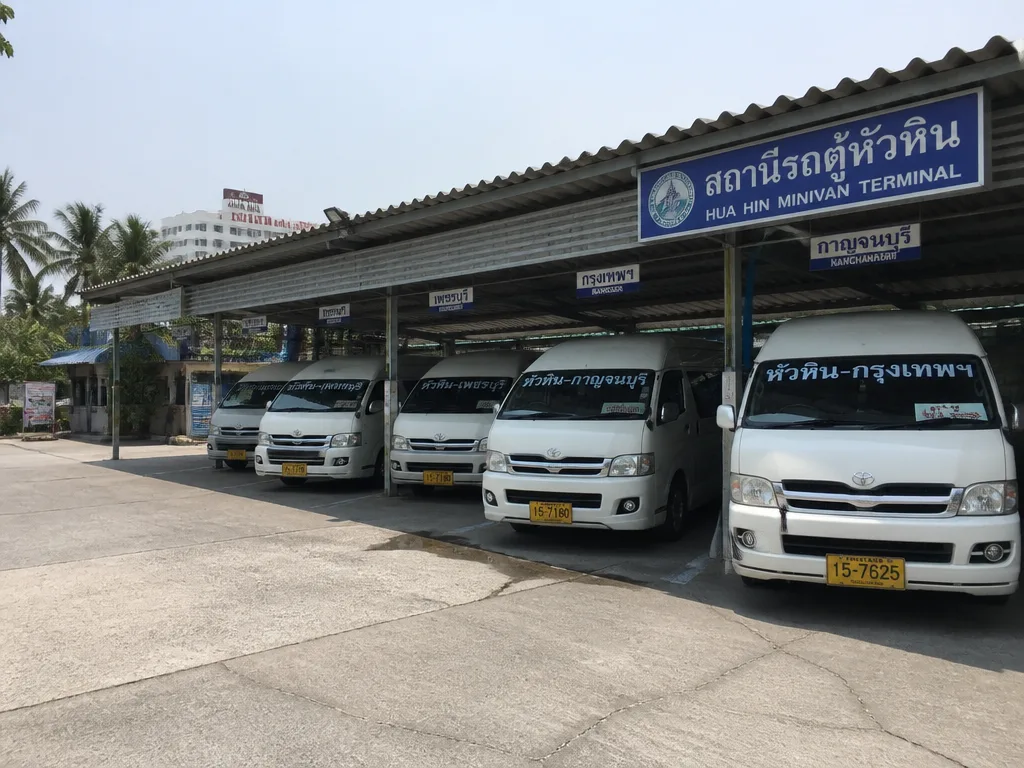
Minivan from Ekkamai or Mo Chit (most common): ฿180–250 one-way (about $5.50–7.50). Roughly 3 to 3.5 hours, departures every 30–60 minutes through the day. Ekkamai’s Eastern Bus Terminal is the easiest pickup if you live anywhere along the BTS Sukhumvit line. Mo Chit (the new van terminal next to the BTS) covers North Bangkok. Vans drop you at the Hua Hin minivan terminal in town, then it’s a ฿80–150 motorbike taxi or Bolt to your hotel.
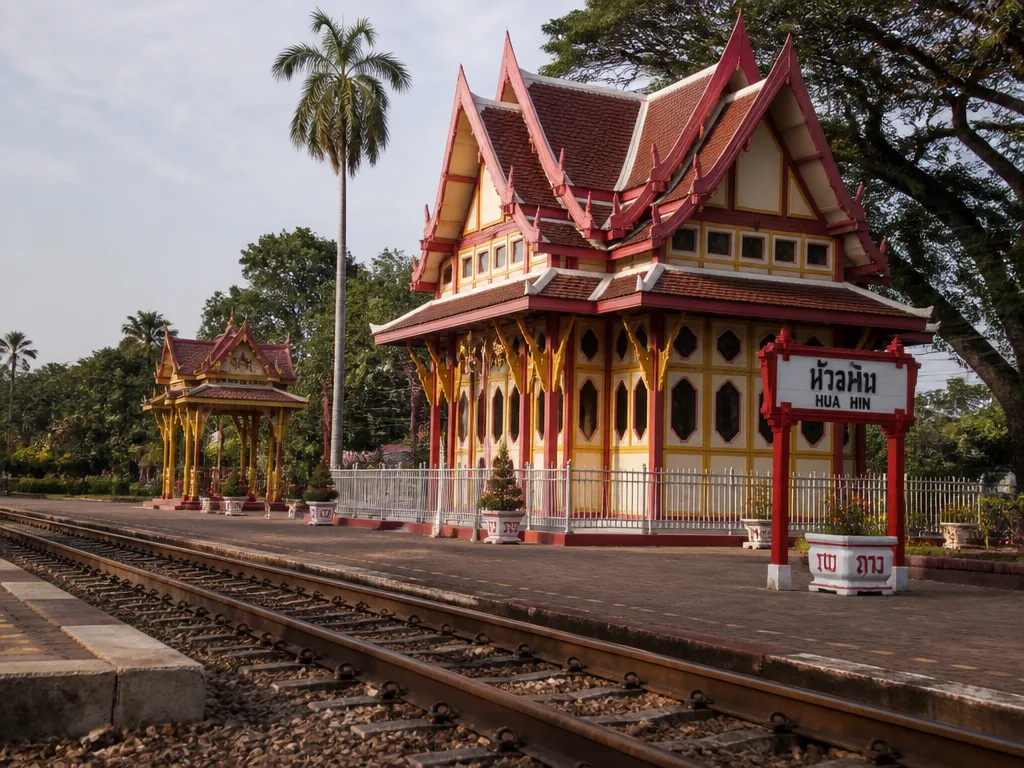
Train from Hua Lamphong / Krung Thep Aphiwat: ฿44–500 depending on class, 3.5–4.5 hours. The cheapest train is a third-class fan car for the price of a coffee. The romance is real (the Hua Hin railway station is one of the most beautiful in the country) but the train is slow, and since the line moved to the new Krung Thep Aphiwat (Bang Sue) terminus, getting to the station from central Bangkok is itself a 30-minute trip. Worth doing once for the experience, not the default.
Private car / Bolt / Grab intercity: ฿2,000–3,500 (about $60–105), 2.5–3 hours door-to-door. The fastest option. Book through Klook for a fixed-price transfer or arrange via your hotel; the Klook search for Hua Hin transfers shows current rates. Important: standard Bolt and Grab in Bangkok will not accept a 3-hour intercity ride. Drivers reject these because they can’t get a return fare. See our Bangkok Grab and Bolt guide for how the apps actually work. For Hua Hin you need a pre-booked private driver, not a hailed app ride.
TIP
If you’re two adults with luggage and you value time, the private driver is worth the extra ฿1,500. Door-to-door, no waiting, no taxi-from-the-terminal scramble at the other end. Split between four people, it’s per-head competitive with the van.
For broader context on getting around the country, our Bangkok transportation guide covers the BTS/MRT/airport-link maze that gets you to the van terminal in the first place.
Where to Stay: The Three Zones
Hua Hin runs along a long, thin strip of coast. Where you sleep dramatically changes what your weekend feels like.
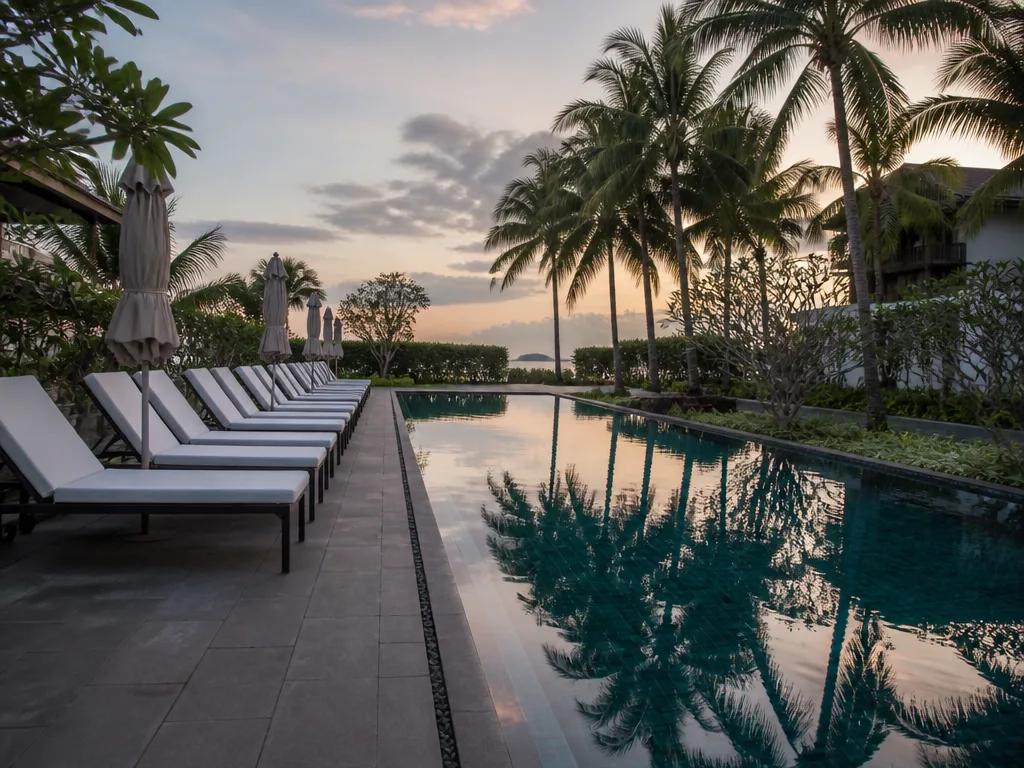
Hua Hin Town (the default first-visit base). The original heart of Hua Hin. The old railway station, Chatchai Market, the night market on Soi 72, walkable seafood restaurants, and the Hilton/InterContinental/Centara Grand all sit within a 15-minute walking radius. The beach in front of town is okay (more on that below), but the real reason to base here is convenience. First-timers should default to town unless they specifically want a quieter, more resort-bound experience.
- Centara Grand Beach Resort & Villas (the old Railway Hotel, opened 1923, ฿4,500–9,000/night)
- Hilton Hua Hin (in-town tower, big pool, ฿3,500–6,500/night)
- InterContinental Hua Hin Resort (lagoon pool, mid-town beachfront, ฿5,000–9,500/night)
- Cape Nidhra Hotel (boutique, plunge-pool suites, ฿4,500–8,000/night)
Khao Takiab (south, “Monkey Hill” area). Five kilometers south of town. Quieter, longer stretches of beach, and the location of most of the bigger resort developments. The Hyatt Regency, Anantara, and Sheraton are all down here. You trade walkability for a better beach and a calmer mood. Cicada Market is also down this way, which is a real plus if you’re visiting on a weekend.
- Hyatt Regency Hua Hin (213 rooms, the longest hotel beachfront in Hua Hin, ฿5,500–11,000/night)
- Anantara Hua Hin Resort (low-density, more intimate, ฿6,500–13,000/night)
- V Villas Hua Hin – MGallery (private pool villas, ฿15,000+ /night)
Cha-Am (north, ~25 km up the coast). A separate beach town that locals sometimes lump in with Hua Hin. Cheaper, more Thai-domestic-tourist energy, longer flatter beach, much less to walk to at night. Best for budget travelers or repeat visitors who already know they want a hammock-and-book weekend. Not recommended for a first visit unless you’re price-driven.
Beach Reality: Don’t Expect Phuket
This is the single most important paragraph in this guide.
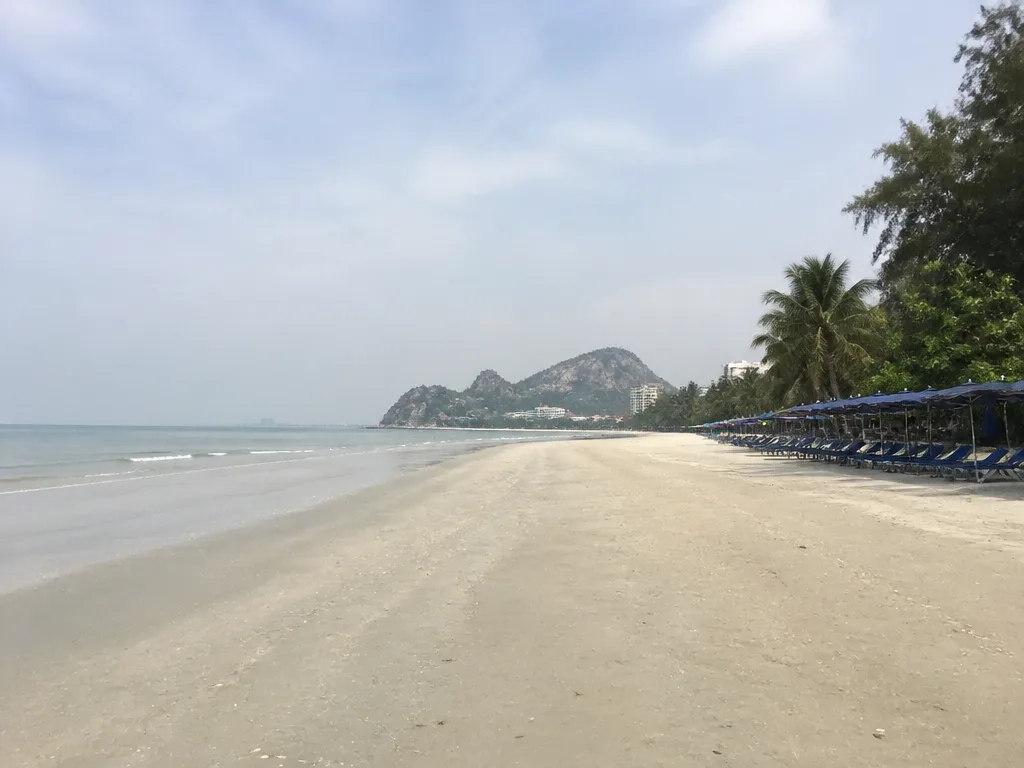
The Hua Hin beach is not the Andaman Sea. It sits on the upper Gulf of Thailand, the water is murky-to-greenish year round, the sand is more beige-to-grey than white, and at low tide some stretches turn into a wide flat mudflat. There is no “crystal water” version of Hua Hin. There never has been. Anyone selling you on Hua Hin as a tropical beach paradise has either never been to Phuket or is trying to sell you a condo.
What Hua Hin Beach is: a long, wide, walkable, mostly safe-to-swim stretch of coast that’s perfectly fine for a sunset stroll, a horse ride (yes, horse rides on the beach are a Hua Hin thing), a hotel pool day with occasional sand breaks, and decent shallow-water swimming for kids and non-swimmers. The water quality is closer to a respectable European seaside town than a Thai island.
If beach quality is your top trip priority, go to Krabi or Phuket instead. If you want a Thai resort town with a beach as the backdrop rather than the centerpiece, Hua Hin is great.
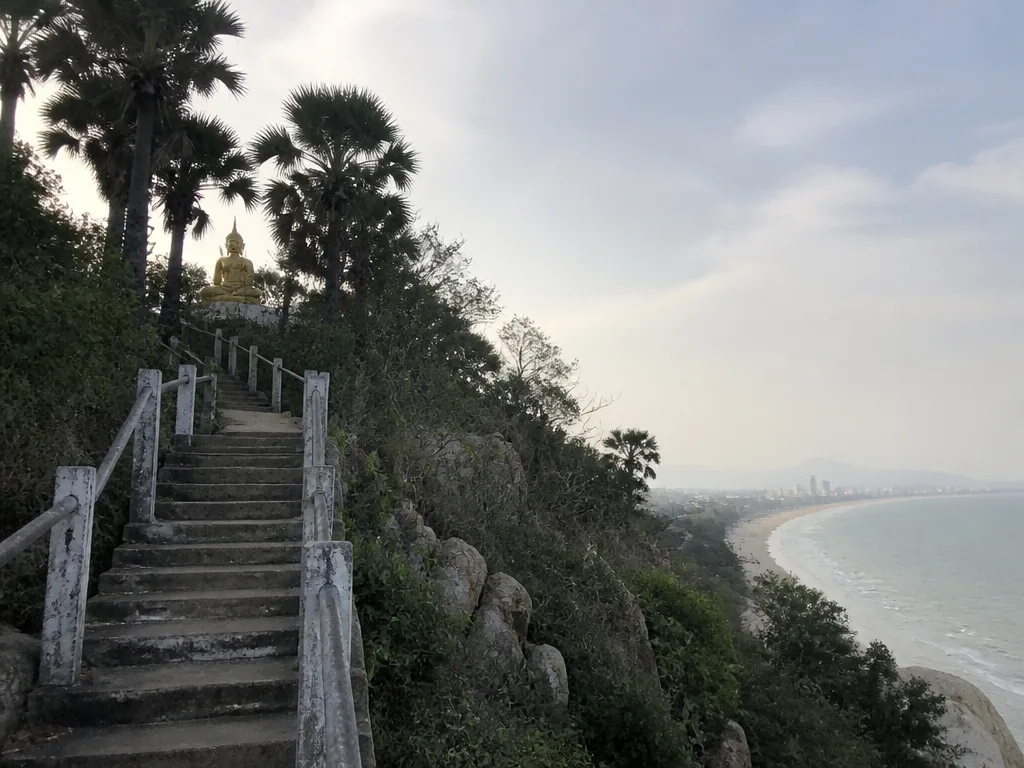
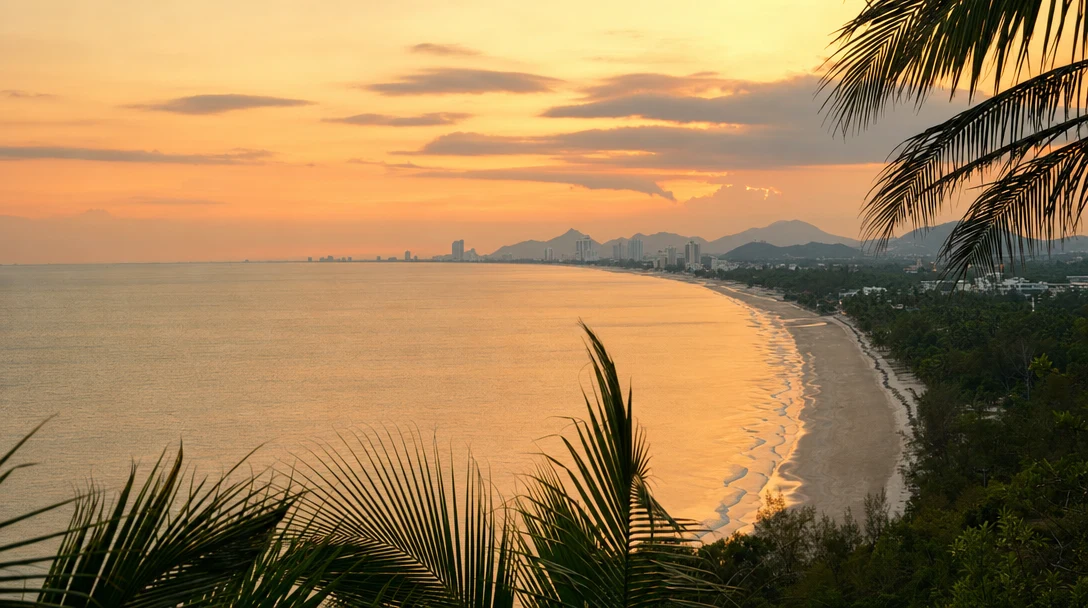
The best beach segment is in front of the InterContinental and Centara Grand in the town area, and the Khao Takiab stretch in the south. The headland itself (a small forested hill topped with a temple complex and famously inhabited by a sizable troop of monkeys) is one of the few proper postcard views in Hua Hin. Climb the steps for the panoramic gulf view, but watch your sunglasses and snacks. The monkeys are professional.
What to Actually Do
The list of “must-do” Hua Hin sights is short, and that’s a feature. Pick three or four and you have a weekend. Trying to do all of them is a mistake.
Hua Hin Railway Station. The single most photographed building in town. A red-and-cream Victorian wooden station from the 1920s with a separate Royal Waiting Room (the Phra Mongkut Klao Pavilion) originally built as part of Sanam Chandra Palace in Nakhon Pathom and moved here. As of late 2023, train operations moved to a new station next door, so the old building is now a free walk-in heritage attraction, open all day, no ticket. Twenty minutes is enough.
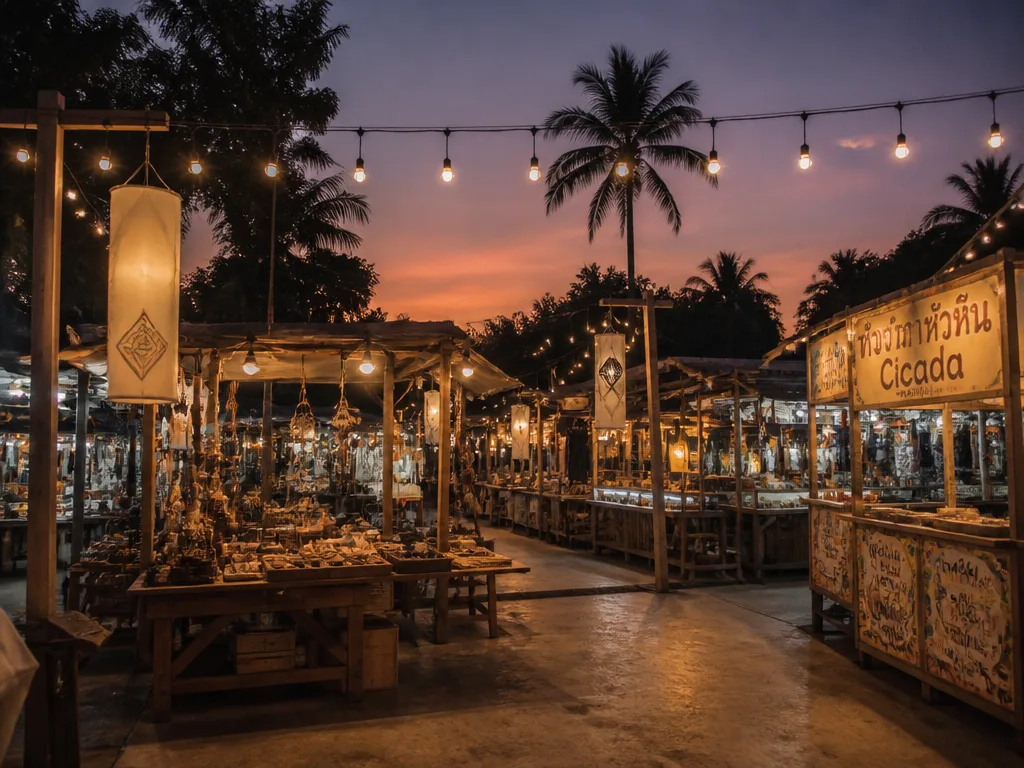
Cicada Market (weekend nights only). Open Friday, Saturday, Sunday from 4 PM to 11 PM. Located in Khao Takiab, near the Hyatt Regency. This is the best-curated night market in southern Thailand: handmade crafts, art stalls, live music on multiple stages, and a food court that’s well above the usual tourist-market mark. Show up at 6:30 PM, eat dinner there, stay until 9 PM. If you’re in Hua Hin midweek, you miss it entirely, so plan around this.
Khao Takiab (Monkey Hill). The small headland at the south end of Hua Hin Beach. Climb the steps to the temple complex at the top for a wide view of the coast back toward town. Free, open daylight hours, takes about 45 minutes round trip. The monkeys will steal anything not nailed down, so leave bags in the car and don’t bring food.
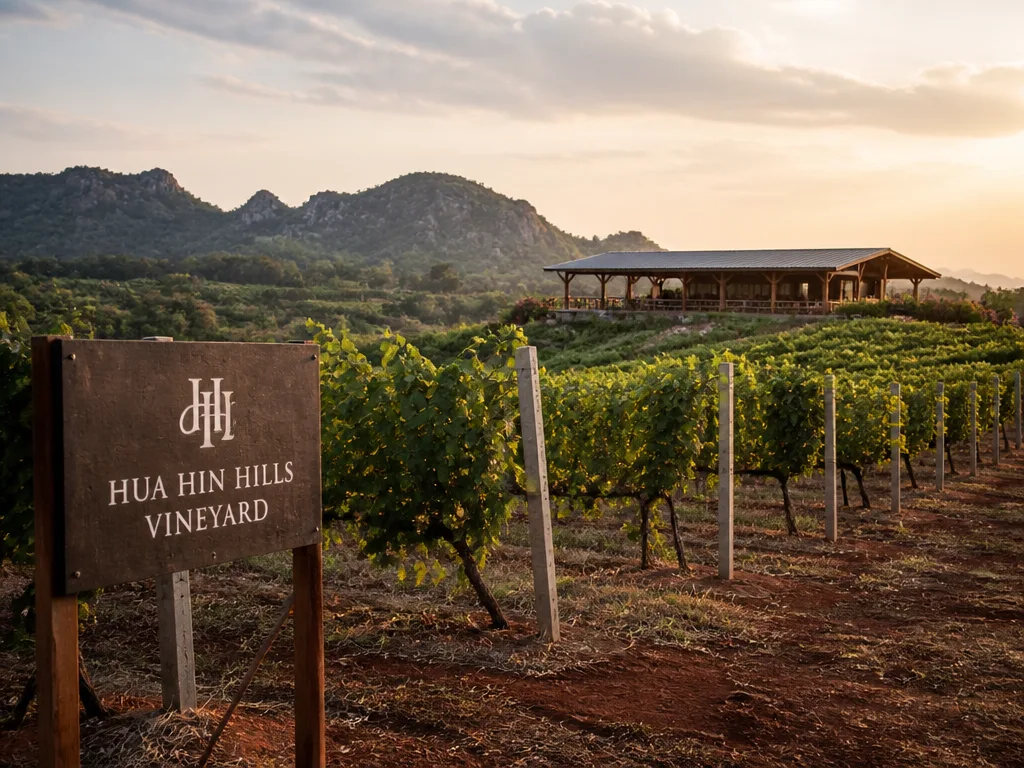
Hua Hin Hills Vineyard. A 45-minute inland drive from town, in the mountains toward Pa La-U. Thailand’s most-photographed vineyard, with a tasting room, a restaurant overlooking the vines, and short hiking trails. The wine itself is fine, not transcendent, but the setting at golden hour is genuinely worth the trip. Free entry, wine tastings ฿300–500. Easiest as a half-day with a hired driver (฿1,500–2,000 round trip from town).
Black Mountain Water Park. A real water park with slides, a lazy river, and a wave pool, 20 minutes inland. Day pass ฿700–900 for adults, ฿500–700 for kids. The single best family activity in Hua Hin if you have kids 6+. Skip if you’re not traveling with children.
Sam Phan Nam Floating Market. ฿200 entry, open 10 AM to 9 PM. It’s a constructed market designed to look like an old riverside town. Mixed reviews: some travelers love the photo opportunities, others find it manufactured for tour buses. Worth a one-hour stop if you’re driving past, not a destination in itself.
A note on Plearn Wan. If you’ve seen the vintage-village photos in older Hua Hin guides (pastel shopfronts, 1950s nostalgia, retro candy stalls), those are from Plearn Wan, which permanently closed in January 2020. The site is shuttered. Don’t drive out there. Older guides on the internet still list it as a top attraction, and that’s how you can tell they haven’t been updated since the pandemic.
Food Scene
Hua Hin’s food story is two-track: tourist-priced seafood by the beach, and excellent cheap eats inland.
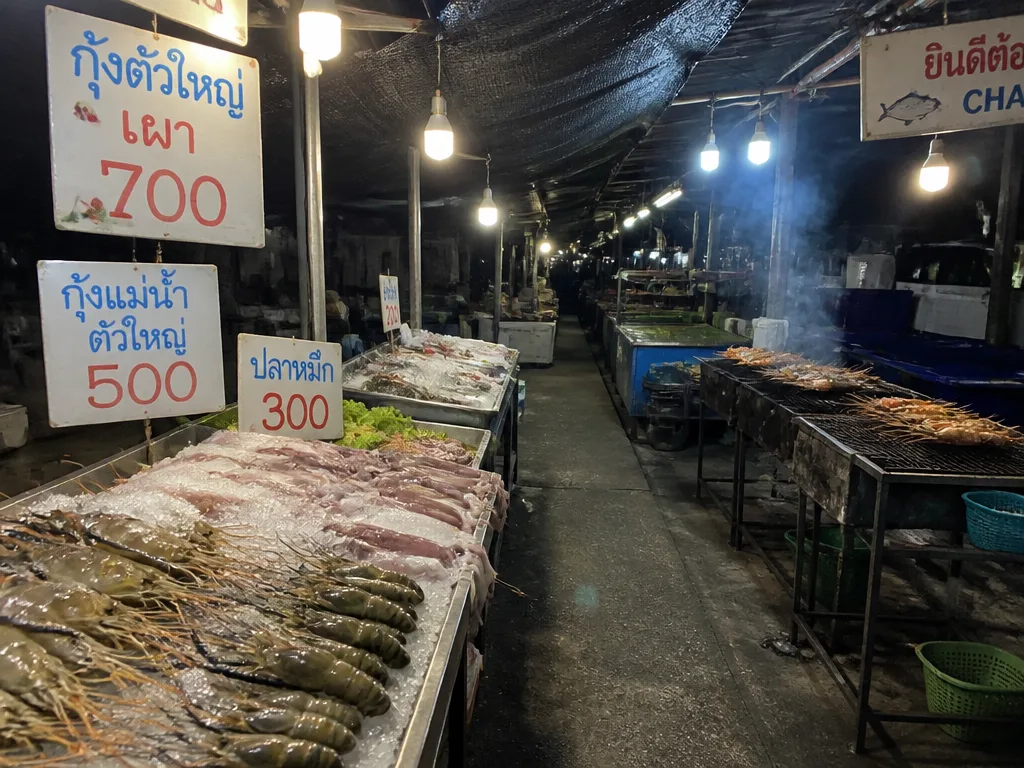
Chatchai Market and the Hua Hin Night Market (Soi 72). Walk these in the same evening; they’re a block apart. Chatchai is the older daytime fresh market that becomes part of the night market spillover. The Soi 72 stretch is the seafood-grill strip where every restaurant has live fish, prawn, crab, and squid on ice out front, you point, they grill. Expect ฿400–900 per person for a full seafood meal with drinks. The pad thai and som tam stalls in the same block are ฿60–80.
Soi 51 / Soi 55 (in-town locals’ alleys). A block back from the beach road, these narrow sois are where you eat at half the price of the beachfront spots. Boat noodles, khao mun gai, southern Thai curries, all in the ฿50–100 range.
Brunch / cafe scene. Hua Hin has quietly become a respectable cafe town: second-wave coffee, brunch plates, Australian-style flat whites in the ฿80–150 range. Look around the Hua Hin Town Center side streets and the area just north of the railway station. The cafe density is much higher than what a town this size suggests, which is part of the charm.
Resort restaurants. The high-end hotel restaurants (Hyatt’s Italian, Anantara’s Thai fine dining) are good and expensive at ฿1,500–3,000 per person for a tasting-level meal. Worth a single splurge night if your hotel is in Khao Takiab and you don’t feel like a taxi-into-town round trip.
Golf
Hua Hin is, quietly, the best golf destination in Thailand. Three courses you’ll see recommended constantly:
Black Mountain Golf Club. The marquee course. Ranked among the top in Asia, with elevation changes, mountain views, and an attention to maintenance that the rest of Thailand mostly can’t match. Green fees ฿3,500–4,400 for 18 holes in high season, plus ฿350 caddie and ฿750 compulsory cart. Book ahead.
Banyan Golf Club. Newer than Black Mountain (opened 2008), built into the hills west of town. Slightly cheaper, similarly excellent. ฿3,000–3,800 green fees plus caddie/cart.
Royal Hua Hin Golf Course. Thailand’s oldest golf course, opened in 1924 by a Scottish railway engineer. Walking distance from the Hua Hin railway station. Green fees ฿1,600–2,200, by far the cheapest of the three, and the historic value is real, but it’s a step down in conditioning from Black Mountain. Good for a half-day round on arrival day.
If golf is more than a side trip, if it’s the reason you’re coming, our Thailand golf guide covers green fees nationwide and the caddie culture that makes a round here good value.
2-Day vs 3-Day Itinerary
The 2-day weekend (one night): Leave Bangkok Friday afternoon, back Sunday evening.
- Friday 4 PM: Van from Ekkamai, arrive Hua Hin 7:30 PM
- Friday 8 PM: Check in, walk to Chatchai Night Market for seafood dinner
- Saturday 9 AM: Hua Hin Railway Station + brunch
- Saturday 12 PM: Hotel pool / beach
- Saturday 4 PM: Cicada Market for dinner and live music (Khao Takiab side)
- Sunday 10 AM: Khao Takiab temple climb
- Sunday 1 PM: Lunch, check out
- Sunday 3 PM: Back to Bangkok
The 3-day weekend (two nights): Same template, plus one of:
- A half-day at Hua Hin Hills Vineyard (afternoon, ending at golden hour)
- A morning round at Royal Hua Hin or Banyan
- A Black Mountain Water Park day if you’re with kids
- A long pool-and-spa morning at the hotel (the Hyatt’s Barai Spa is consistently rated one of Asia’s best)
NOTE
If you’re going specifically for Cicada Market, your Friday-to-Sunday weekend timing is correct (Fri/Sat/Sun only). A Monday-to-Wednesday trip misses it.
Common First-Timer Mistakes
Coming midweek. Half of Hua Hin’s evening identity is the weekend night markets. Cicada is Friday/Saturday/Sunday only. Show up Tuesday and the town feels half-asleep.
Booking too far south without a plan to get back to town. Khao Takiab resorts are 10–15 minutes from town by car. If you don’t pre-arrange transport or you arrive on the late van and try to Bolt to a Khao Takiab hotel, you’ll lose 30 minutes hunting a ride. Have the hotel send a transfer, or book a Klook transfer end-to-end.
Expecting beach perfection. See the beach section above. Hua Hin has a beach. Hua Hin is not a beach destination in the Phuket sense.
Renting a scooter as a first-time rider. Hua Hin’s main road (Phetkasem Highway) carries tour buses and trucks at speed. If you’ve never ridden a scooter, this is not the place to learn.
Trying to do Hua Hin as a day trip from Bangkok. It’s been done, but you’ll spend six hours in vehicles for four hours on the ground. Not worth it. Either commit to one night or pick a closer destination.
Frequently Asked Questions
How long should I stay in Hua Hin?
Two nights is the sweet spot for a first visit. One night works but feels rushed because Cicada Market alone needs a full evening. Three nights opens up Hua Hin Hills Vineyard plus a golf round or Black Mountain Water Park. Day trips from Bangkok don’t work: the round-trip drive eats six hours and you miss every evening attraction.
How much does a Hua Hin trip cost?
A two-night Hua Hin weekend runs 6,000–12,000 THB per person all-in (about $180–365). That covers a 4-star town hotel at 3,500–6,500 THB per night, the round-trip Ekkamai van at 500 THB, and 1,500–2,500 THB per day for food and one paid activity. Budget travelers can do it on 3,500 THB total. Luxury resorts in Khao Takiab triple the hotel line.
Is Hua Hin better than Pattaya?
Hua Hin is calmer, more upscale-Thai, and stronger on golf and vineyards. Pattaya is louder, more international, and stronger on nightlife. Pattaya has a better beach via Koh Larn day trip. Hua Hin has a better town. Most Bangkok residents end up doing both: Pattaya for a 2-night party leg, Hua Hin for a quieter long weekend or a family trip.
How do I get from Bangkok to Hua Hin?
Three main options. The Ekkamai or Mo Chit minivan is the default at 180–250 THB and 3–3.5 hours, running every 30–60 minutes. The train from Krung Thep Aphiwat costs 44–500 THB and takes 3.5–4.5 hours, romantic but slow. A private Klook transfer runs 2,000–3,500 THB door-to-door in 2.5–3 hours, the fastest option for two adults with luggage.
What is the best time to visit Hua Hin?
November through February is the peak: cool dry-season air, low humidity, and the lowest rainfall. December and January are the most expensive and most crowded. March through May is workable but hot at 35°C. June through October is monsoon season with afternoon storms, but Hua Hin sits in a partial rain shadow, so it’s more viable than the Andaman coast at the same time.
Are Hua Hin beaches good for swimming?
The beach is safe for swimming but not picturesque. The Gulf water is murky-to-greenish year-round, the sand is beige-to-grey rather than white, and low tide turns some stretches into mudflats. It works for shallow swimming with kids, sunset walks, and horse rides. If postcard Andaman water is the priority, go to Krabi or Phuket instead.
The Bottom Line
Hua Hin is the right answer to a very specific question: “Where in Thailand can I go for a long weekend without an airport, without paying island prices, and without being in Pattaya?” The beach isn’t postcard material. The town is. The food is excellent. The golf is the country’s best. And the three-hour van ride from Ekkamai is the path of least resistance for the 12 million people who live in Bangkok.
Pick a weekend with Cicada Market in your dates. Stay in town for your first visit. Walk the railway station, eat at Chatchai, climb Khao Takiab, drink wine at the vineyard at golden hour. Do those four things and you’ve had a complete Hua Hin trip in 48 hours.
For the broader weekend-from-Bangkok decision tree (Hua Hin vs Khao Yai vs Ayutthaya vs Kanchanaburi), see our Bangkok weekend escapes guide. For when to time it across the year, best time to visit Thailand has the month-by-month picture.
Further Reading
- Pattaya first visit, the other Bangkok weekend escape, compared
- Thailand golf guide, Black Mountain, Banyan, and Royal Hua Hin in context
- Bangkok Grab & Bolt guide, why the apps don’t work intercity
- Bangkok transportation, getting to Ekkamai or Mo Chit for the van
- Best time to visit Thailand, month-by-month weather picture
- Bangkok weekend escapes, Khao Yai, Ayutthaya, Kanchanaburi as alternatives