Every first-timer to Bangkok ends up Googling the same question at 2 AM the night before their flight: “Where do I exchange money in Bangkok?” The answer that keeps coming up is SuperRich. Then a second question follows immediately: “Wait, there’s a green one and an orange one — which one do I go to?”
After a decade of living here and exchanging more currencies than I care to admit, I can tell you the difference matters less than the internet makes it seem. But the details still matter, and getting them wrong means leaving real money on the table.

Green SuperRich or Orange SuperRich — Which Is Better?
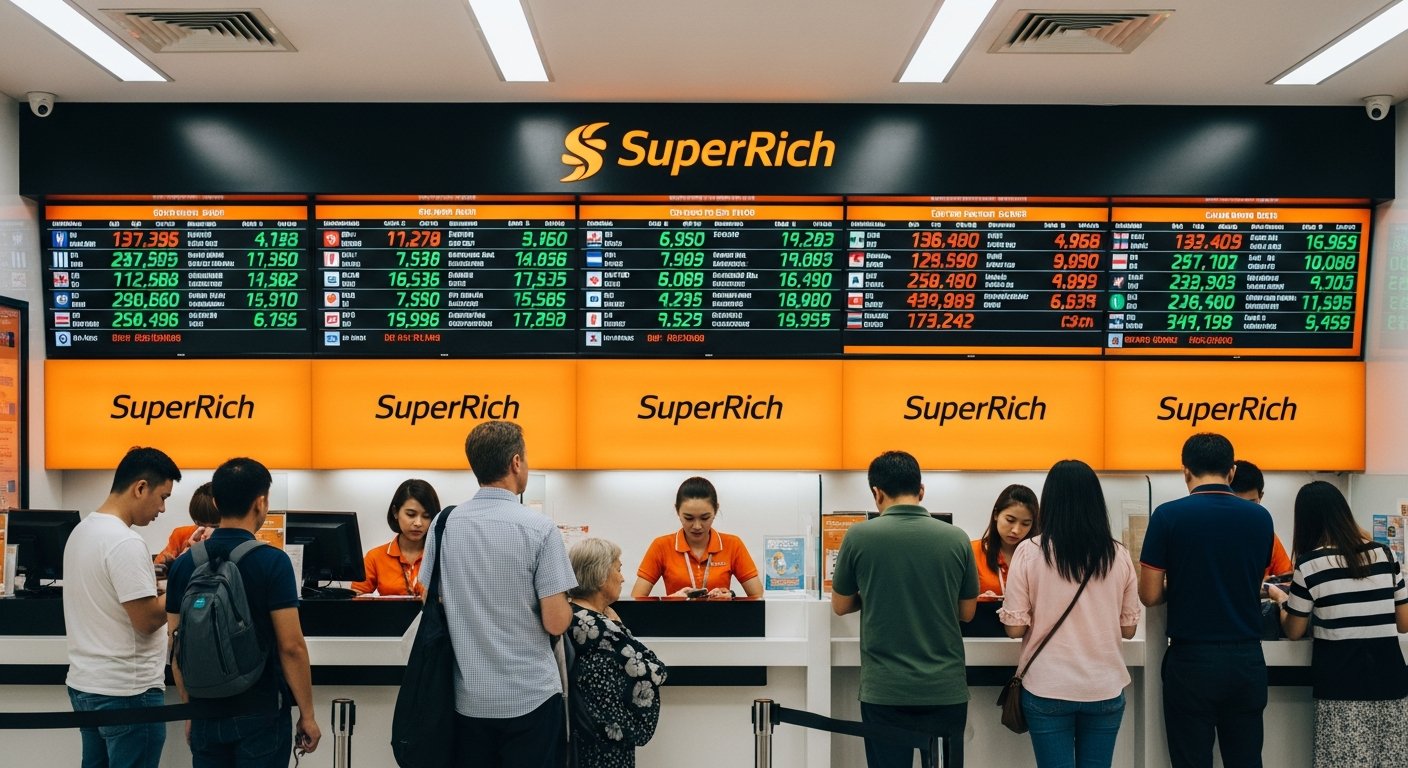
Let’s settle this once and for all. SuperRich Thailand (green logo) and SuperRich 1965 (orange logo) are two separate companies. They’re not branches of the same chain. They were founded by relatives, split apart, and now compete directly with each other. The rivalry is real, and it works in your favor.
TIP
Check both SuperRich websites the morning you plan to exchange. If rates are the same, go to Orange — shorter wait times.
The honest answer: The rates are nearly identical on any given day. We’re talking differences of 0.01-0.05 THB per unit of foreign currency. On a $500 exchange, that’s roughly 5-25 THB difference — less than the cost of a bottle of water.
That said, there are patterns worth knowing.
Green SuperRich tends to edge out Orange on major currencies like USD, EUR, GBP, and JPY. Their Pratunam headquarters has consistently offered the tightest spreads I’ve seen in Bangkok. They also seem to update their rates more frequently throughout the day.
Orange SuperRich occasionally wins on less common Asian currencies — Korean Won, Taiwanese Dollar, Vietnamese Dong. If you’re coming from a smaller Asian economy, check both before committing.
The real differentiator isn’t the rate. It’s the wait. Green SuperRich Pratunam (their flagship) can have 30-60 minute queues during peak tourist season. Orange SuperRich branches are generally less crowded because fewer travel blogs recommend them by name.
Green vs Orange: The Comparison
| Factor | SuperRich Green | SuperRich Orange |
|---|---|---|
| Official name | SuperRich Thailand | SuperRich 1965 |
| Rates (major currencies) | Slightly better on USD, EUR, GBP, JPY | Comparable, occasionally better on KRW, TWD |
| Number of locations | 10+ branches across Bangkok | 8+ branches across Bangkok |
| Flagship | Pratunam (Rajdamri Rd) | Pratunam (nearby, same area) |
| Wait times | Can be long, especially Pratunam | Generally shorter |
| Hours | 9:00 AM - 6:00 PM (varies by branch) | 9:00 AM - 6:00 PM (varies by branch) |
| Online rate check | superrichthailand.com | superrich1965.com |
| Minimum exchange | None | None |
My recommendation: Check both websites the morning you plan to exchange. Go to whichever has the better rate for your currency. If the rates are the same, go to Orange — you’ll wait less.
The Airport Exchange Trap
You land at Suvarnabhumi. You’re tired. You see the exchange booths in the arrivals hall with their bright signs and think, “I’ll just do it here.”
Don’t.
WARNING
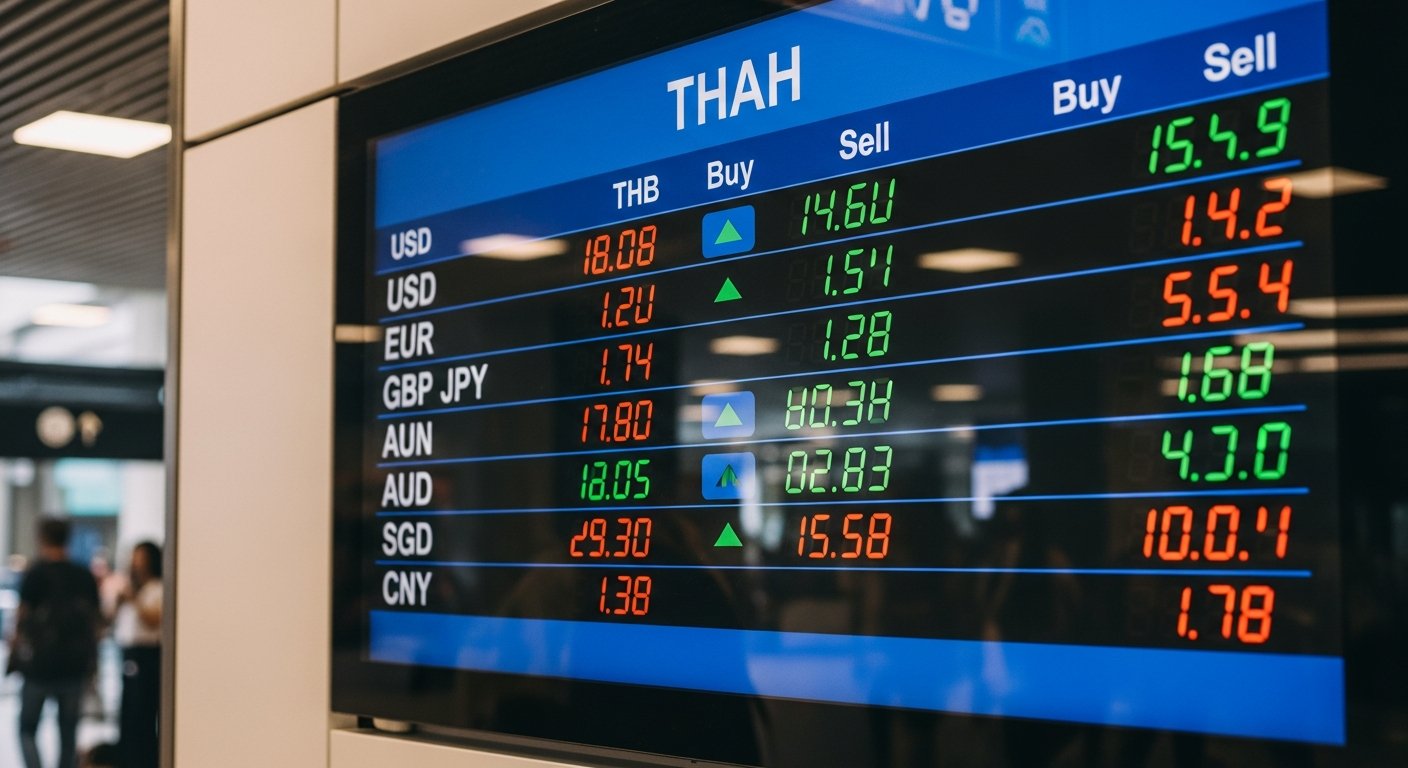
Airport exchange booths give rates 5-10% worse than city exchanges. On $500, that’s 800-1,600 baht lost for the convenience of not taking a 20-minute train ride.
Airport exchange booths in Bangkok give rates 5-10% worse than city exchanges. On $500, that’s ฿800-1,600 you’re giving away for the convenience of not taking a 20-minute train ride.
What to do instead: Exchange the bare minimum at the airport — ฿1,000-2,000 is enough for the Airport Rail Link ticket (฿45), a taxi or Grab to your hotel (฿200-400), and your first meal. Exchange the rest at SuperRich or another city exchange office the next morning.
There is one exception. The SuperRich booth in Suvarnabhumi’s basement level (B floor, near the Airport Rail Link entrance) offers rates significantly better than the arrivals hall booths. It’s not quite as good as city rates, but if you need a larger amount immediately, it’s the smartest airport option. Look for it before you exit the airport — most people walk right past it.
Best Exchange Locations by Area
You don’t need to trek across Bangkok to find good rates. Here are the best options organized by the areas where tourists actually stay.
| Area | Nearest BTS/MRT | Exchange Shop | Notes |
|---|---|---|---|
| Pratunam | BTS Ratchathewi / Chit Lom | SuperRich Green (flagship), SuperRich Orange, Vasu | Best rates in Bangkok. Worth the trip if exchanging $300+ |
| Siam | BTS Siam | SuperRich Green (Siam Paragon), K79 (MBK area) | Convenient for shopping day, good rates |
| Asok / Nana | BTS Asok / MRT Sukhumvit | SuperRich Green (Exchange Tower), Vasu (Soi 7) | Best option for Sukhumvit hotel guests |
| Silom / Sathorn | BTS Sala Daeng / MRT Silom | SuperRich Green (Silom Complex), multiple independent shops | Solid rates, lots of competition |
| Khao San Road | None (taxi/tuk-tuk) | Multiple independent shops along Khao San | Decent rates, convenient for backpackers. Verify with SuperRich website first |
| Suvarnabhumi Airport | Airport Rail Link | SuperRich (B Floor) | Best airport option, still worse than city |
The Pratunam Pilgrimage
If you’re exchanging a significant amount — say $500 or more — the Pratunam area is worth the detour. SuperRich Green’s headquarters on Rajdamri Road consistently posts the best exchange rates in Bangkok, sometimes beating even their own branch offices by a small margin.
The area around Central World and Platinum Fashion Mall has the highest concentration of exchange offices in the city. Competition keeps everyone honest. If the queue at Green SuperRich is insane (it happens), walk 50 meters and you’ll find three alternatives with nearly identical rates.
Pro tip: Go early. SuperRich opens at 9:00 AM and the first hour is the quietest. By 11:00 AM on a Saturday, you’re looking at a serious wait.
The ฿220 ATM Fee Trap
This is the single most expensive mistake tourists make in Thailand, and they make it repeatedly.
IMPORTANT
Always decline the ATM’s offer to charge you in your home currency (Dynamic Currency Conversion). Their markup is 3-5% worse than your bank’s rate. Choose “charge in Thai Baht” every time.
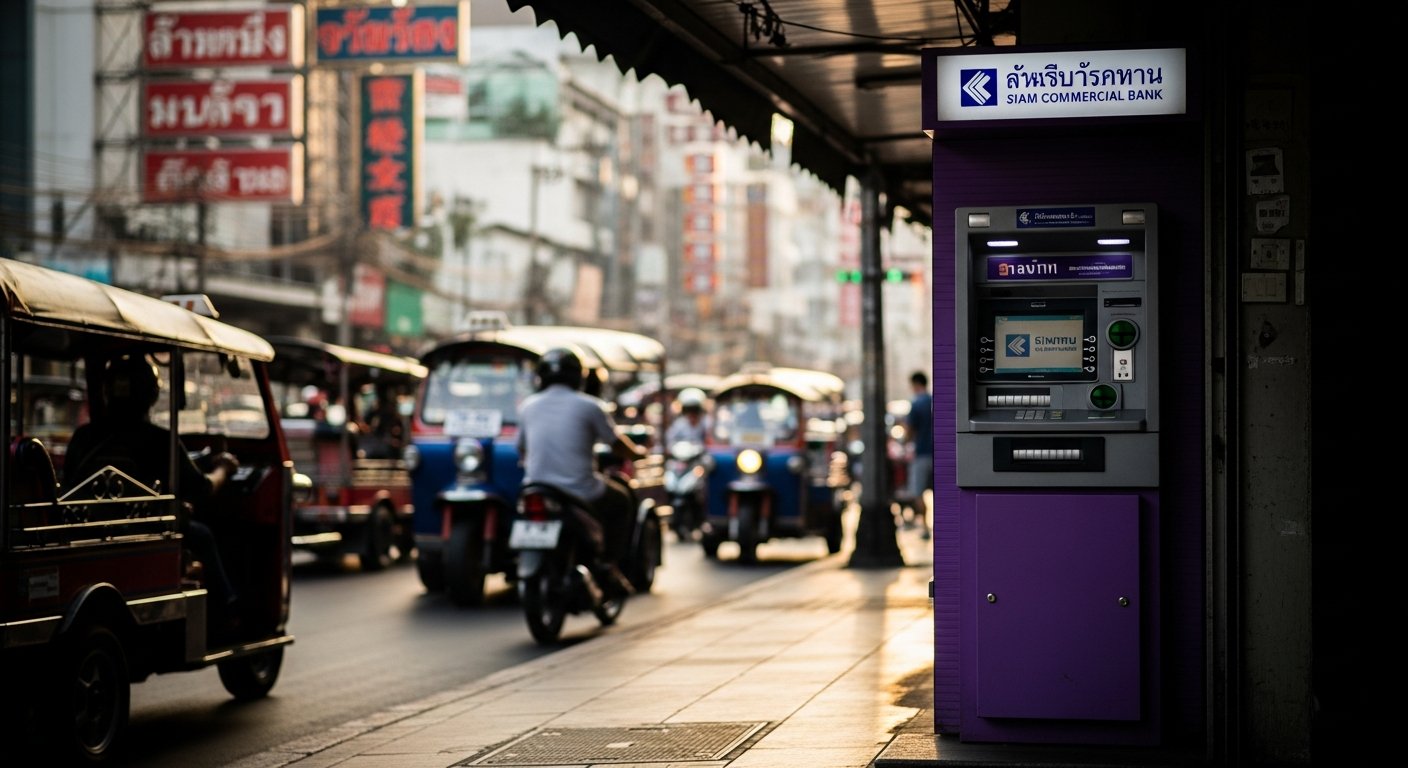
Every Thai ATM charges a flat ฿220 fee (roughly $6 USD) per withdrawal for foreign cards. This is a Thai bank surcharge — it’s on top of whatever your home bank charges for international withdrawals. There is no way to avoid it. It applies to all foreign debit and credit cards, regardless of your bank, your country, or which ATM network you use.
Do the math: if you withdraw ฿3,000 at a time, that ฿220 fee represents a 7.3% surcharge. Withdraw ฿20,000 and it drops to 1.1%. The strategy is obvious.
How to minimize the damage:
- Withdraw large amounts — ฿10,000-20,000 per transaction. Most ATMs allow up to ฿20,000-30,000 per withdrawal depending on the bank
- Use exchange offices instead of ATMs whenever possible. Cash exchange has zero per-transaction fees
- Bangkok Bank and Kasikorn ATMs are the most reliable for foreign cards. Avoid unmarked standalone ATMs in tourist areas
- Always decline the ATM’s exchange rate — When an ATM asks if you want to be charged in your home currency (Dynamic Currency Conversion), always say no. Their markup is 3-5% worse than your bank’s rate. Choose “charge in Thai Baht” every time
Some travelers report that Aeon ATMs (found inside AEON stores and certain shopping malls) occasionally waive the ฿220 fee. This isn’t guaranteed and seems to vary, but it’s worth checking if you spot one.
For a broader overview of managing money and connectivity on arrival, see our Money and SIM Card guide.
Wise and Revolut: The Smarter Alternative
If you’re reading this before your trip, the single best thing you can do for your travel budget is set up a Wise (formerly TransferWise) or Revolut card.
These fintech cards use the real mid-market exchange rate with a small transparent fee — typically 0.5-1.5% total. Compare that to the 3-5% markup most traditional bank cards charge on foreign transactions, plus the ฿220 ATM fee.
How to use them in Bangkok:
- Card payments: Tap to pay at malls, restaurants, 7-Eleven, and any shop with a card terminal. You get the mid-market rate with minimal fees. No ฿220 ATM surcharge because you’re not using an ATM
- ATM withdrawals: Both Wise and Revolut allow limited free ATM withdrawals per month (Wise offers 2 free withdrawals up to a certain amount; Revolut’s free tier includes a monthly free ATM allowance). You still pay the ฿220 Thai ATM fee, but you avoid the bad exchange rate
- Topping up: Load your card with your home currency before the trip. Convert to THB at market rate within the app whenever the rate looks good
Wise vs Revolut for Thailand: Both work well. Wise is simpler and more transparent with fees. Revolut offers more features (crypto, budgeting tools) but the free tier has tighter ATM limits. Either one will save you significant money compared to a traditional bank card.
Important: These cards are for spending, not for large cash needs. If you need ฿20,000+ in cash, exchanging physical bills at SuperRich still gets you a slightly better rate than any card.
How Much Cash Should You Bring?
This depends on your trip style, but here are real numbers based on current Bangkok prices.
Budget traveler (hostels, street food, public transit): ฿1,500-2,000 per day. Bring $300-400 in cash for a 7-day trip, plus a Wise/Revolut card for backup.
Mid-range traveler (3-star hotel, mix of street food and restaurants, occasional taxi): ฿3,000-4,000 per day. Bring $500-700 in cash for 7 days.
Comfortable traveler (4-star hotel, restaurants, activities, nightlife): ฿5,000-8,000 per day. Bring $700-1,000 in cash, but rely on cards for hotel and upscale dining.
What currency to bring: US dollars get the best exchange rates at Thai exchange offices. If your home currency isn’t USD, consider converting to USD before your trip — the two-step exchange (home currency to USD, then USD to THB) often nets a better result than a direct conversion. EUR, GBP, AUD, JPY also get competitive rates. Smaller currencies may get poor rates or may not be accepted at all.
“If you’re reading this before your trip, the single best thing you can do for your travel budget is set up a Wise or Revolut card.”
Bill condition matters: Bring clean, uncreased, unmarked bills. Thai exchange offices will reject torn, written-on, or heavily worn notes. This isn’t a quirk — it’s standard policy. USD $100 bills get better rates than smaller denominations ($50, $20), so bring hundreds if possible.
NOTE
USD $100 bills get better exchange rates than smaller denominations ($50, $20), so bring hundreds if possible.
Cash on entry: Thailand technically requires proof of funds to enter the country (฿20,000 for tourists, ฿10,000 for certain visa types). Immigration rarely checks, but it does happen. Having a reasonable amount of cash satisfies this requirement if asked.
Exchange Rate Timing Tips
Exchange rates fluctuate throughout the day and across weeks. A few timing strategies can stretch your budget.
Check rates before you go: Both SuperRich Green (superrichthailand.com) and Orange (superrich1965.com) post live rates on their websites. Compare with Google’s rate to see how close they are to mid-market.
Weekdays beat weekends: Exchange offices that are open on weekends sometimes offer slightly worse rates. Monday through Friday generally gives you the best spread.
Don’t exchange everything at once: If you’re staying two weeks or longer, exchange in two or three batches. Rates move, and spreading your exchanges averages out the fluctuations. Exchange enough for your first 4-5 days, then reassess.
Avoid exchanging at hotels: Hotel front desk exchange rates are universally terrible — 8-15% worse than SuperRich. The convenience is not worth the cost.
If you need basic Thai phrases for navigating exchange offices, our language guide covers the essentials. For guidance on how tipping affects your daily cash needs, check our Tipping Guide. And for getting around the city efficiently on a budget, our Bangkok Transportation Guide covers every option.
Frequently Asked Questions
Can I use credit cards everywhere in Bangkok?
Not everywhere. Cards work at malls, chain restaurants, hotels, 7-Eleven, and most sit-down restaurants. But street food stalls, market vendors, small local restaurants, motorcycle taxis, and many massage shops are cash only. Plan to use cash for roughly 40-60% of your daily spending, depending on where you eat and shop.
Is it better to exchange money before I leave home or in Bangkok?
In Bangkok, almost always. Exchange offices in Western countries, airports, and banks typically offer rates 5-15% worse than SuperRich in Bangkok. The only exception is if your home city has a competitive Thai Baht exchange (some Asian cities do). Otherwise, bring clean USD or your home currency and exchange upon arrival.
Do I need Thai Baht before landing in Bangkok?
No. You can exchange at the airport immediately after clearing immigration. The arrivals hall exchange booths are open 24 hours. As mentioned above, exchange only the minimum at the airport (฿1,000-2,000) and get better rates in the city.
What happens if I run out of cash?
ATMs are everywhere in Bangkok — literally every 7-Eleven has one nearby, and there’s a 7-Eleven on every block. You’ll pay the ฿220 fee, but you won’t be stranded. Alternatively, if you have a Wise or Revolut card, use contactless payment wherever cards are accepted.
Are there exchange scams I should watch out for?
Stick to established exchange offices — SuperRich, Vasu, K79, and shops in major malls — and you’ll be fine. Avoid random individuals offering to exchange money on the street. At legitimate exchanges, always count your money before leaving the counter. The rate displayed is the rate you get; there are no hidden fees at reputable offices.