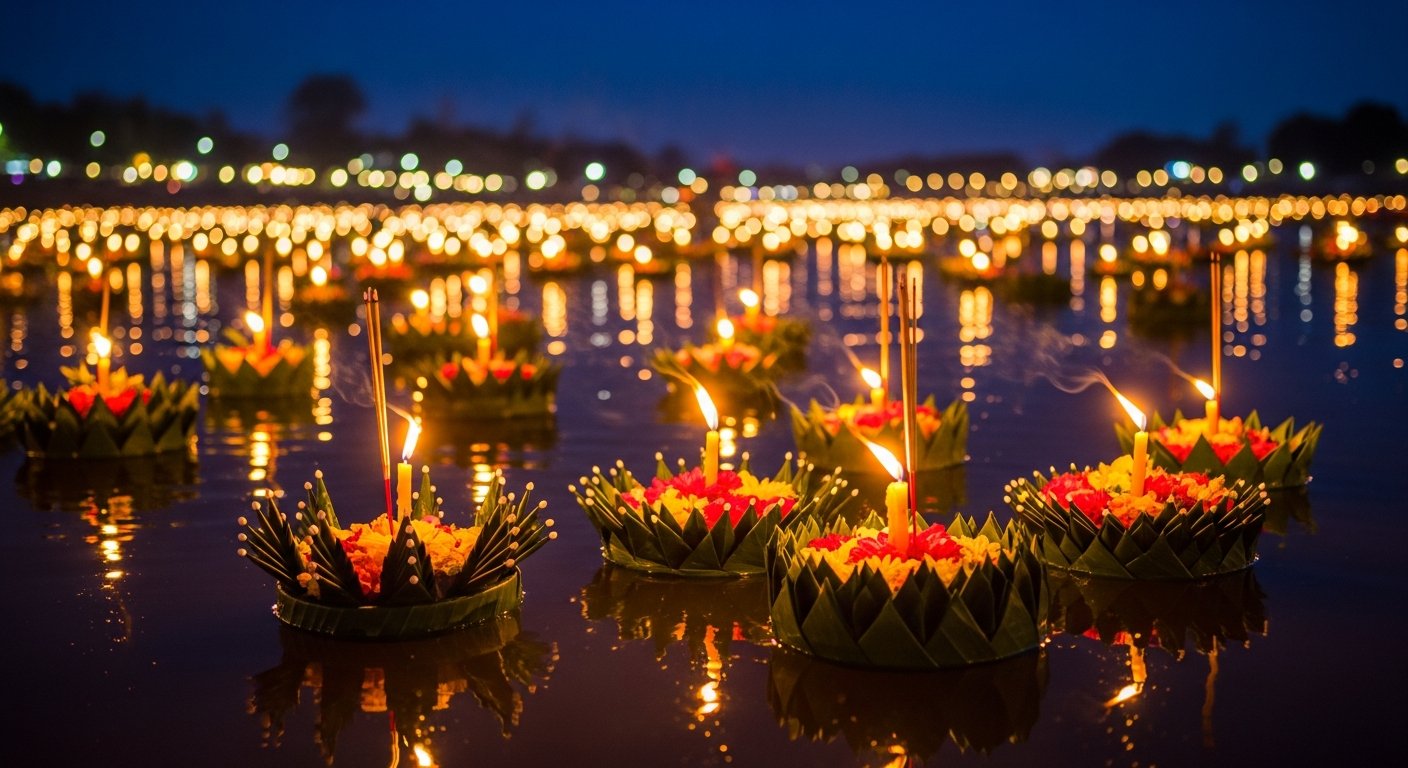
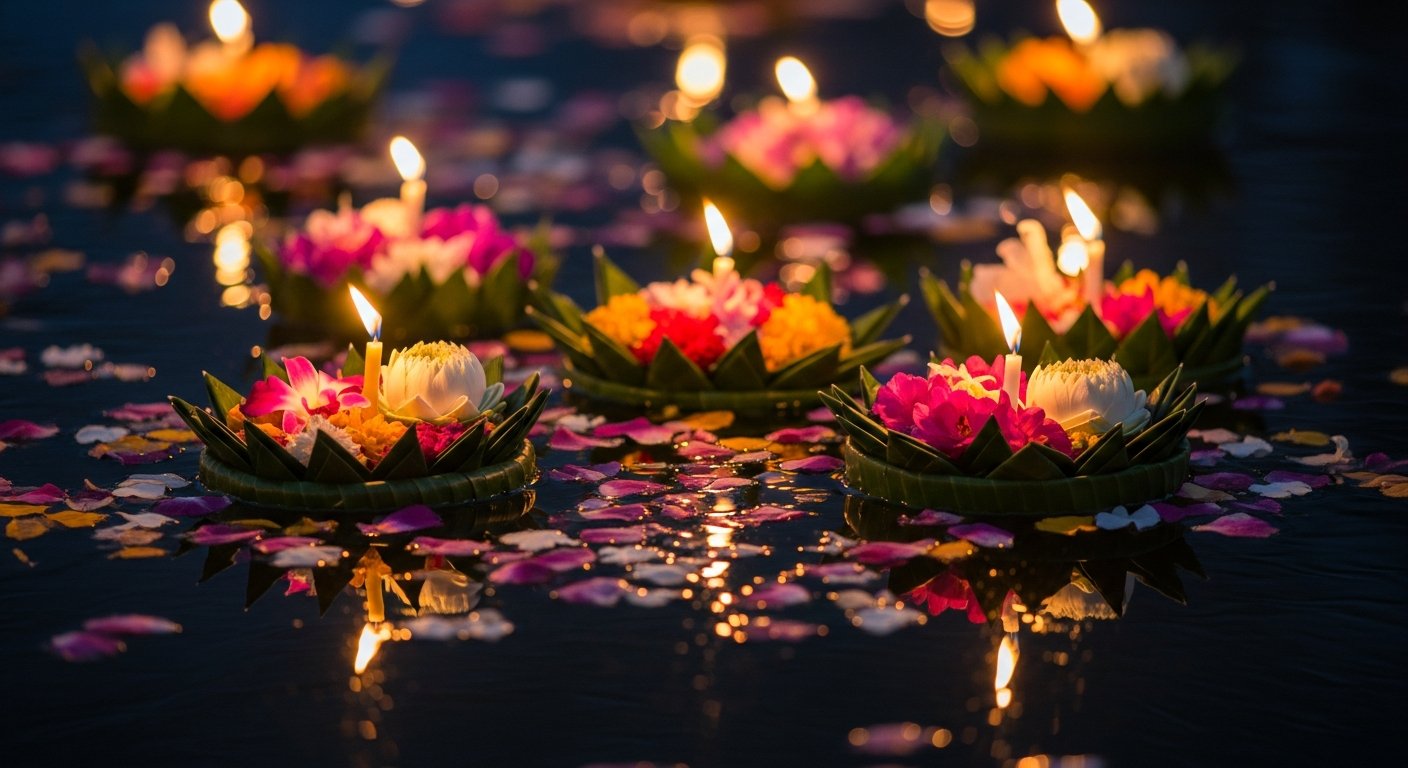
Loy Krathong is the most beautiful night of the year in Thailand. On the full moon of the twelfth Thai lunar month — typically mid-November — the country’s rivers, canals, lakes, and ponds fill with thousands of small floating offerings made of banana leaves and flowers, each carrying a candle, three sticks of incense, and a quiet wish. The name says it: loy means “to float,” krathong is the offering vessel. It’s an act of letting go — releasing anger, grievances, and misfortune onto the water, and asking Mae Khongkha, the goddess of water, for forgiveness.
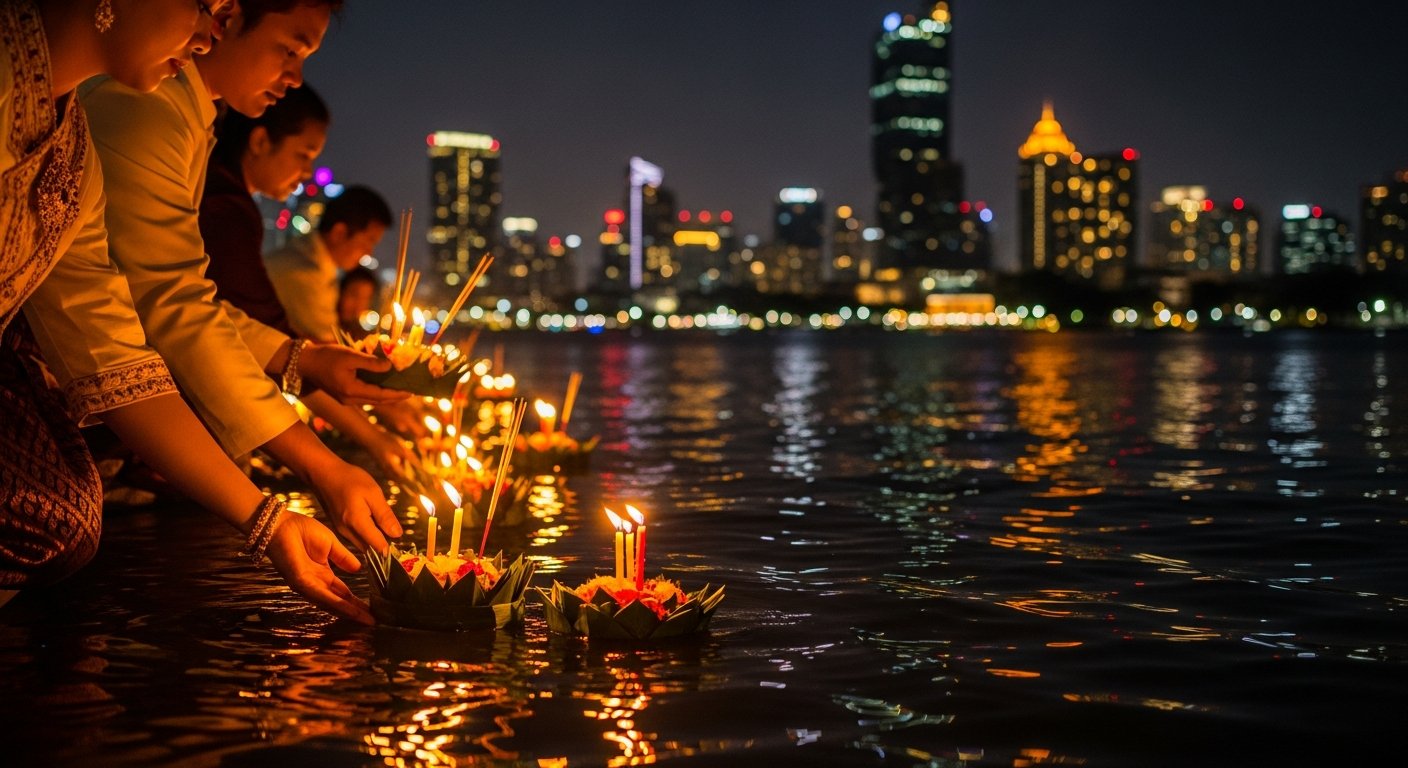
I’ve seen ten of these now. The first time, in 2016, I floated a store-bought krathong from a concrete pier at Asiatique and thought it was nice. By the third or fourth year, I understood what Thai friends had been telling me all along — that the festival isn’t really about the spectacle. It’s about the moment you crouch at the water’s edge, light the candle, place your hands in a wai, and push the krathong gently into the current. There’s a silence in that gesture, even in a crowd of thousands, that stays with you.
Here’s everything you need to know to experience it properly.
When Is Loy Krathong?
Loy Krathong falls on the full moon of the twelfth month of the Thai lunar calendar, which almost always lands in November. The exact date shifts each year.
Upcoming dates:
- 2026: November 5
- 2027: November 25
- 2028: November 13
The main celebrations happen on the full moon night itself, but many venues and parks begin festivities the evening before and continue through the weekend if the date falls near one. Arrive at your chosen spot by late afternoon to secure a good position — things get crowded fast once the sun goes down.
What Is a Krathong (and Should You Make or Buy One)?
A krathong is a small, lotus-shaped vessel traditionally made from a cross-section of banana tree trunk, decorated with folded banana leaves, flowers, incense sticks, and a candle. You’ll also see a coin placed inside — an offering, not payment for wishes.
Buying one is easy. Street vendors appear everywhere on Loy Krathong evening — outside temples, along riverbanks, near BTS stations — selling krathongs ranging from simple banana-leaf versions (20-50 baht) to elaborate multi-tiered creations with orchids and ribbons (100-300 baht). The cheaper ones are honestly better for the river. They’re lighter and float longer.
Making one is the more meaningful route if you have time. Many hotels and community centers offer afternoon krathong-making workshops on the day of the festival, usually free for guests or 100-200 baht for walk-ins. The process takes about 30 minutes: you fold banana leaves into petal shapes, pin them onto the trunk base with small wooden sticks, arrange flowers, and add the candle and incense. It’s meditative work, and floating something you built with your own hands hits differently.
The eco angle: Choose organic. Traditional banana-leaf krathongs are fully biodegradable — they soften and dissolve within days. Styrofoam krathongs, which were common a decade ago, are now widely discouraged and banned at most official venues. Bread-based krathongs (marketed as “fish food”) have also fallen out of favor because they alter water quality. Stick with banana leaves and natural flowers. The river doesn’t need your bread.
Where Is the Best Place for Loy Krathong in Bangkok?
Bangkok offers dozens of spots, but three stand out for different reasons. The Chao Phraya River is the iconic choice — this is the waterway that defines the city, and floating your krathong here connects you to centuries of the same tradition. Benjakitti Park offers a modern, crowd-managed experience with better photography conditions. Asiatique is the easiest option for tourists staying in central Bangkok.
| Spot | Vibe | Crowd Level | Best For |
|---|---|---|---|
| Chao Phraya River piers | Traditional, atmospheric, slightly chaotic | Very high | The authentic experience, photographers |
| Benjakitti Park | Modern, calm, well-organized | Moderate | Families, first-timers, relaxed evening |
| Asiatique The Riverfront | Tourist-friendly, festive, commercial | High | Convenience, combining with dinner/shopping |
| Lumpini Park | Local, low-key | Moderate-low | Escaping crowds, neighborhood feel |
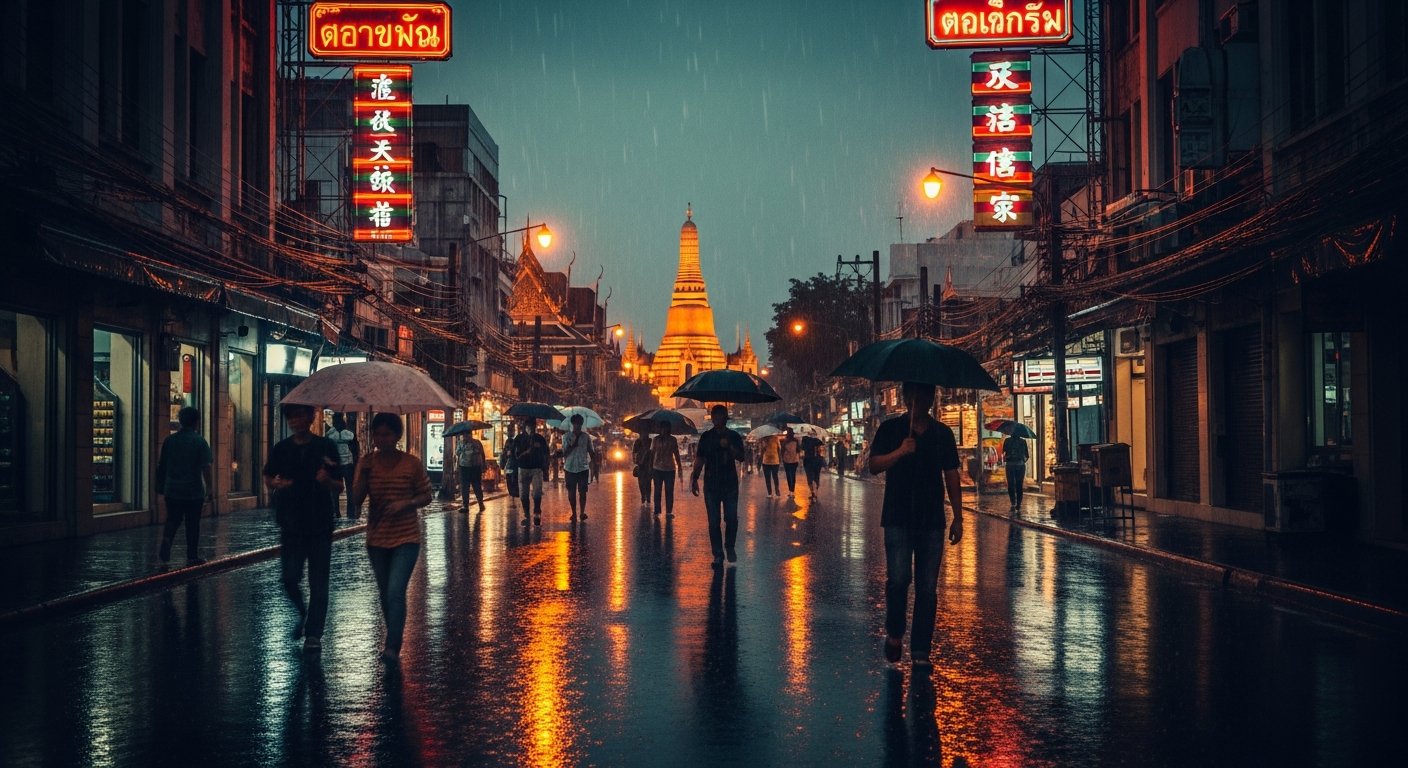
Chao Phraya River is where you want to be if atmosphere matters more than comfort. The piers near Wat Arun and the area around Phra Pinklao Bridge become a sea of candlelight. The reflection of temple spires and krathong flames on the dark water is the image you’ve seen in every Loy Krathong photograph — and it’s genuinely that beautiful in person. Getting there is straightforward: take the BTS to Saphan Taksin, then a river boat to the pier nearest Wat Arun. See our Bangkok transportation guide for the full breakdown of river boats and how they work.
The downside is crowds. At peak hour (7-9 PM), the major piers are shoulder-to-shoulder. Arrive by 5:30 PM for a comfortable spot at the water’s edge. By 7 PM, you’ll be three rows back.
Benjakitti Park has become a local favorite since its renovation. The lake provides calm water — your krathong won’t immediately drift into a passing barge — and the park’s modern landscape gives you space to breathe. The city skyline reflecting behind the floating candles is a newer, distinctly Bangkok version of the tradition. MRT Queen Sirikit Centre station is a two-minute walk.
Asiatique The Riverfront runs a proper festival with stages, performances, food stalls, and a designated krathong-floating area. It’s commercial, yes, but also well-organized and genuinely fun. If you’re traveling with kids or prefer having dinner options and entertainment beyond the floating itself, this is the practical choice. Free shuttle boat from Saphan Taksin BTS.
Bangkok vs. Chiang Mai: Two Different Festivals
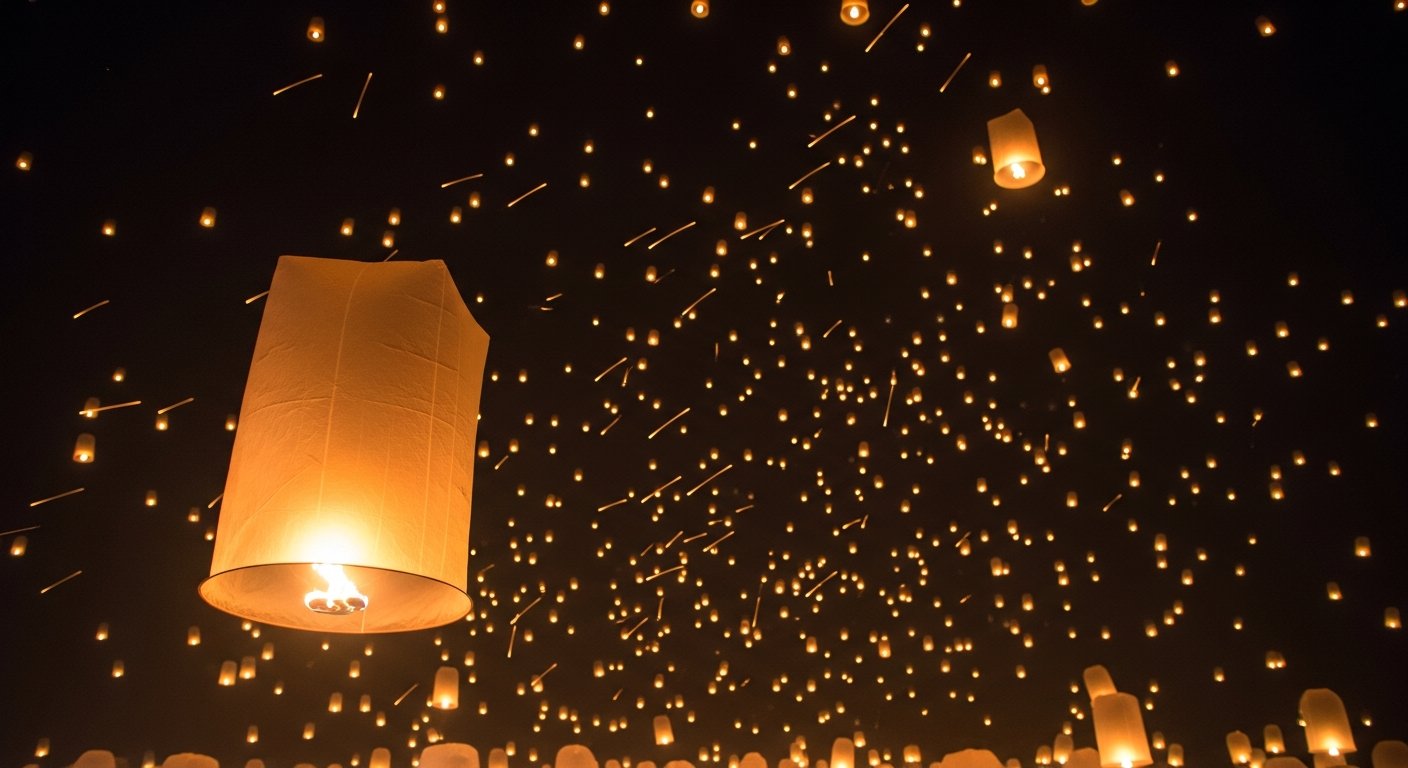
Here’s something that confuses first-timers: Loy Krathong and Yi Peng are not the same festival. Loy Krathong is the water festival — krathongs on rivers — and it’s celebrated nationwide. Yi Peng is the Lanna sky lantern festival specific to northern Thailand, particularly Chiang Mai. They happen to fall on the same full moon night, which means Chiang Mai gets both: krathongs floating below and lanterns drifting above. It’s spectacular.
If you can only pick one city, pick Chiang Mai. I say that as someone who lives in Bangkok. The combination of fire on the water and fire in the sky, set against the moat and ancient walls of the Old City, is one of the most visually staggering things you’ll witness in Thailand. The scale of Yi Peng — hundreds of paper lanterns rising simultaneously in warm light against a dark sky — crosses into the genuinely transcendent.
The Chiang Mai experience centers around the Old City moat. Locals and visitors gather along the moat walls to float krathongs in the still water while releasing khom loi (sky lanterns) overhead. Wat Phan Tao and Wat Chedi Luang, both inside the Old City, host some of the most atmospheric celebrations with thousands of small candles lining the temple grounds. Our Chiang Mai Old City guide covers the layout and temple details.
The mass lantern release events — the ones from the viral videos with a thousand lanterns rising in unison — are organized separately, usually at Mae Jo University grounds north of the city. These ticketed events (typically 3,000-5,000 baht for foreigners) sell out months in advance. Book early if this is your priority. Smaller, spontaneous lantern releases happen throughout the city, but the synchronized mass releases require a ticket.
Important: Chiang Mai authorities increasingly regulate sky lantern releases due to fire risk and aviation safety. In recent years, designated release zones and time windows have been enforced. Releasing lanterns outside approved areas can result in fines. Check local announcements closer to the date.
| Bangkok | Chiang Mai | |
|---|---|---|
| Main tradition | Krathong floating on rivers | Krathong + Yi Peng sky lanterns |
| Atmosphere | Urban, grand, cosmopolitan | Ancient, intimate, otherworldly |
| Crowd management | Spread across many venues | Concentrated around Old City moat |
| Best spot | Chao Phraya piers near Wat Arun | Old City moat, Tha Phae Gate area |
| Getting there | BTS/MRT + river boats | Walking distance from Old City hotels |
| Accommodation | Normal availability | Book 2-3 months ahead |
| Overall impression | Beautiful and convenient | Once-in-a-lifetime |
The Cultural Meaning Behind the Floating
Loy Krathong is often described to tourists as “making a wish,” but that’s a simplification. The core act is about gratitude and release. You’re thanking Mae Khongkha, the water goddess, for the water that sustains life — for drinking, agriculture, transportation, everything — while simultaneously apologizing for polluting and misusing rivers throughout the year. The floating krathong carries away your negativity and bad luck.
There’s also a romantic dimension. Thai couples float krathongs together, and tradition holds that if the two krathongs drift in the same direction, the relationship will endure. Young Thais treat it as one of the most romantic nights of the year — Thailand’s closest thing to Valentine’s Day, but with more fire and fewer roses.
One thing to understand: this is a living tradition, not a performance for tourists. Be respectful at the water’s edge. Don’t push ahead of people who are clearly in a moment of reflection. Don’t shove your phone in someone’s face for a photo as they’re praying. The etiquette principles that apply at temples and royal sites apply here too — you’re welcome to participate, but participate with awareness.
Photography Tips for Loy Krathong
Loy Krathong is one of the most photogenic events in Southeast Asia, but low light and water reflections challenge even good cameras.
Gear: Bring a phone with a solid night mode (anything flagship from the last three years works) or a mirrorless camera. Tripod if you’re serious — the long exposures needed for candlelight and water reflections benefit enormously from stability.
Settings for cameras: ISO 800-1600, aperture wide open (f/1.8-2.8 if you have it), shutter speed 1/30-1/60 for handheld or longer on a tripod. The golden window is right after sunset (6:00-6:30 PM) when there’s still a trace of blue in the sky behind the candlelight — this is the money shot.
Composition ideas:
- Get low to the water. Crouch or kneel at the water’s edge and shoot across the surface to capture the candle reflections stretching toward you
- Frame krathongs against the lit-up temples (Wat Arun from the Maharaj Pier side is extraordinary)
- In Chiang Mai, shoot upward as lanterns rise — include silhouettes of people releasing them for scale and emotion
- Capture the moment of release: hands pushing the krathong away from the edge. This is the human story of the festival
Practical: Waterproof your phone. You’re crouching near water in a crowd. A waterproof case or ziplock bag costs less than a new phone. And charge fully before you leave — night photography drains batteries fast.
Environmental Considerations
The environmental cost of Loy Krathong is real, and Thailand is increasingly honest about it. Bangkok alone has pulled over 500,000 krathongs from the Chao Phraya in a single year. Even biodegradable banana-leaf krathongs take days to break down, and the nails, pins, incense sticks, and coins inside them are not biodegradable at all.
What you can do:
- Choose a 100% organic krathong. Look for ones made entirely from banana leaves, natural flowers, and beeswax candles with no staples, pins, or wire. These are increasingly available and sometimes labeled krathong thammachat (natural krathong)
- Skip the coin. It’s a tradition, but coins don’t decompose and they complicate cleanup
- Use a shared krathong. Floating one krathong as a couple or family rather than one per person halves the impact
- Consider a symbolic release. Some parks and temples now offer “virtual” or single-use communal krathongs that are retrieved after the ceremony. The spiritual intention counts the same
The Thai government and Bangkok Metropolitan Administration run massive cleanup operations the morning after Loy Krathong, deploying hundreds of boats and workers. The organic shift is happening — styrofoam krathongs have essentially disappeared from Bangkok — but the volume remains a challenge.
Timing and Practical Details
Best arrival time: 5:00-5:30 PM. The festival peaks between 7 and 9 PM, and good waterfront positions fill up early. Coming at sunset also gives you the best photography window.
What to wear: Comfortable shoes you can take off easily (you’ll kneel at the water’s edge). Light clothing — November in Bangkok is still warm (28-30 degrees C at night). In Chiang Mai, bring a layer — November evenings can drop to 18-20 degrees C.
Food: Street food vendors set up near every major krathong spot. Expect the usual Thai street food lineup plus seasonal specialties. Eat before you try to claim a spot at the water — juggling som tum and a krathong with a lit candle in a crowd is an advanced move.
Getting around Bangkok: BTS and MRT run normal hours (until midnight). River boats may extend service. Grab surge pricing kicks in hard after 9 PM near the Chao Phraya — either leave early or be prepared to wait. Our Bangkok transportation guide covers every option in detail.
Accommodation in Chiang Mai: If you’re going to Chiang Mai for Loy Krathong/Yi Peng, book your hotel two to three months in advance. Old City guesthouses sell out first. Prices jump 2-3x for the festival week. This is peak season meeting peak event. Check our Chiang Mai Old City guide for neighborhood recommendations.
FAQ
What date is Loy Krathong 2026?
Loy Krathong 2026 falls on Thursday, November 5. Celebrations begin at dusk and continue until late evening. Some venues and parks start festivities the day before.
Is Loy Krathong a public holiday?
No. Loy Krathong is a traditional festival, not an official public holiday in Thailand. Banks, offices, and shops operate normally, though some may close early in the evening so staff can participate. Government offices follow regular schedules.
Can tourists participate in Loy Krathong?
Absolutely. Loy Krathong is one of the most welcoming Thai festivals for visitors. Buy or make a krathong, find a spot at the water’s edge, light the candle and incense, say a quiet wish or prayer, and push it gently onto the water. No special permission or invitation needed. Just approach it with the same respect you’d show at a temple or royal site.
What is the difference between Loy Krathong and Yi Peng?
Loy Krathong is the nationwide water festival — floating krathongs on rivers. Yi Peng is the Lanna (northern Thai) sky lantern festival, celebrated primarily in Chiang Mai. They fall on the same full moon night, so Chiang Mai celebrates both simultaneously. Bangkok has Loy Krathong only; Chiang Mai has both.
Are sky lanterns allowed in Bangkok?
No. Releasing sky lanterns (khom loi) is prohibited in Bangkok and most of central Thailand due to aviation safety near Suvarnabhumi and Don Mueang airports. Violators can face fines. Sky lanterns are a Chiang Mai and northern Thailand tradition. If you want the lantern experience, travel north.