Bangkok is not a vacation destination you visit for a month. It’s a city you move to for a month and then realize you’ve been here for three years. The transition from tourist to resident happens fast — somewhere around week two, when you stop converting baht to dollars in your head and start arguing about which 7-Eleven has the better microwave.
I’ve lived here for a decade and watched thousands of people attempt the one-month experiment. Here’s what actually matters.
How Much Does a Month in Bangkok Actually Cost?
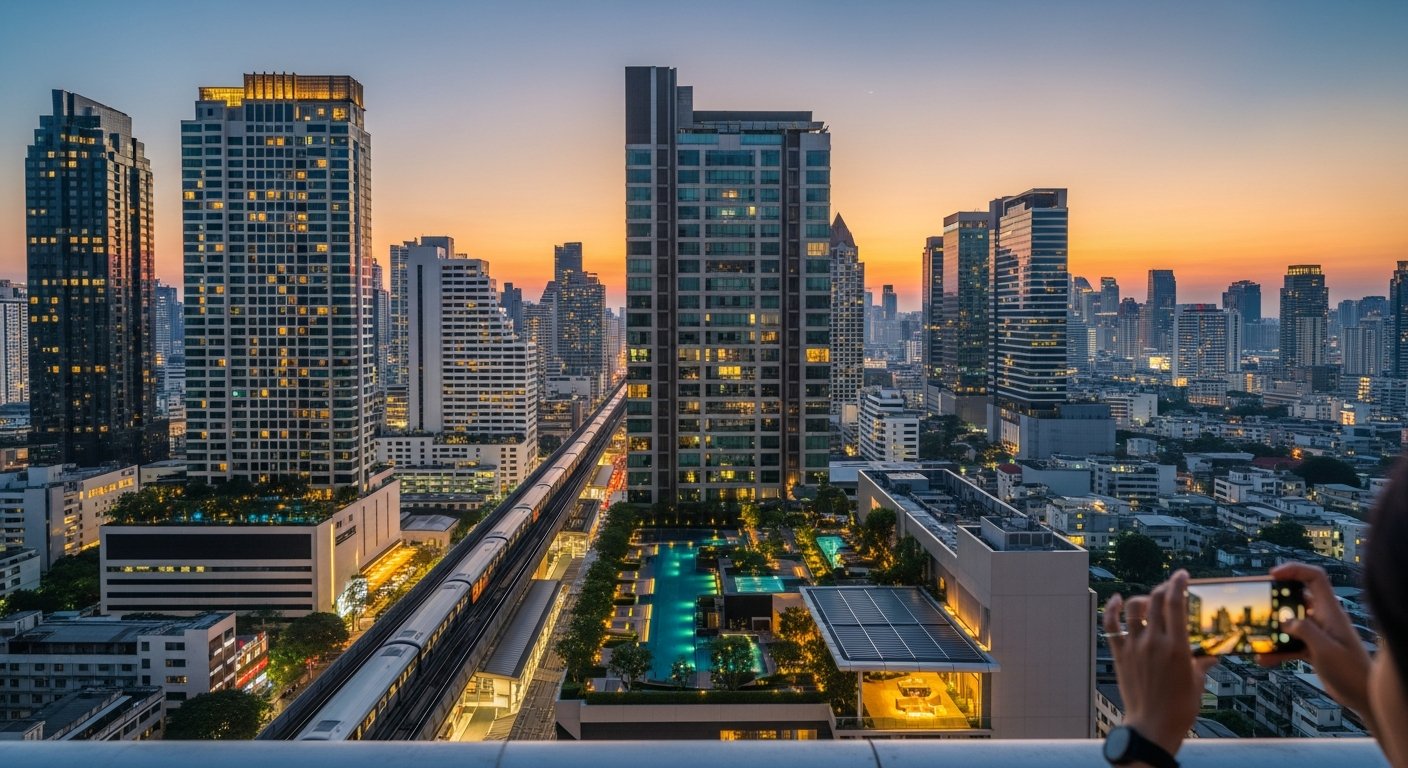
Anywhere from ฿30,000 to ฿100,000+ depending on how you want to live. That’s roughly $850 to $2,800. Here’s the breakdown across three tiers — real numbers, not theoretical minimums that require street food for every meal.
| Category | Budget (฿30,000) | Mid-Range (฿55,000) | Comfort (฿100,000) |
|---|---|---|---|
| Housing | ฿8,000–12,000 | ฿18,000–25,000 | ฿35,000–50,000 |
| Food | ฿8,000–10,000 | ฿12,000–15,000 | ฿20,000–25,000 |
| Transport | ฿1,500–2,000 | ฿3,000–4,000 | ฿5,000–8,000 |
| Coworking/Wifi | ฿0 (cafes) | ฿3,000–5,000 | ฿5,000–8,000 |
| Phone/Internet | ฿500–700 | ฿700–1,000 | ฿1,000–1,500 |
| Entertainment | ฿2,000–3,000 | ฿5,000–8,000 | ฿10,000–15,000 |
| Gym/Wellness | ฿0–1,000 | ฿1,500–2,500 | ฿3,000–5,000 |
| Misc/Buffer | ฿2,000 | ฿3,000 | ฿5,000 |
Budget tier means a studio apartment in On Nut or further out, eating mostly street food and local restaurants, using the BTS as your primary transport, and working from cafes. It’s not suffering — it’s just disciplined.
Mid-range gets you a proper one-bedroom condo in a decent area, a coworking membership, regular Grab rides, and the freedom to eat wherever you want without checking prices. This is where most digital nomads land comfortably.
Comfort tier is a serviced apartment or high-end condo in Thonglor or Ekkamai, eating out at any level, a gym membership, regular massages, and not thinking about money at all. It’s still dramatically cheaper than the equivalent lifestyle in any Western city.
For handling your money efficiently, check out our Bangkok money and SIM card guide — the ATM fee trap alone can cost you ฿1,000+ per month if you’re not careful.
Where Should You Live?
Neighborhood choice matters more for a month-long stay than it does for a vacation. When you’re here for a week, you can tolerate a 40-minute commute to good food. When you’re here for a month, you need good food, a decent cafe, and a 7-Eleven within a five-minute walk of your front door.
| Neighborhood | Monthly Rent (1BR) | Vibe | Best For | BTS Station |
|---|---|---|---|---|
| Ari | ฿12,000–25,000 | Local-creative, walkable | Writers, introverts, cafe lovers | Ari (N5) |
| Thonglor | ฿20,000–45,000 | Trendy, upscale, social | Networkers, foodies, nightlife | Thong Lo (E6) |
| Ekkamai | ฿15,000–30,000 | Quieter Thonglor, residential | Couples, remote workers | Ekkamai (E7) |
| On Nut | ฿8,000–18,000 | Budget-friendly, real Bangkok | Budget nomads, long-stayers | On Nut (E9) |
Ari: The Neighborhood You Didn’t Know You Wanted
Ari is what happens when a quiet residential area gets colonized by Bangkok’s creative class without losing its soul. The streets are walkable by Bangkok standards, the cafe density is absurd, and the food scene ranges from ฿50 street plates to excellent brunch spots. It’s north of the main tourist corridor, which means fewer other foreigners and more authentic neighborhood life.
The trade-off: it’s not on the Sukhumvit nightlife strip. If you want to go out in Thonglor on a Friday night, it’s a 20-minute BTS ride. For most long-stayers, that’s a feature, not a bug.
For a deep dive into what makes Ari work, read our Ari neighborhood guide.
Thonglor: If You Want the Full Experience
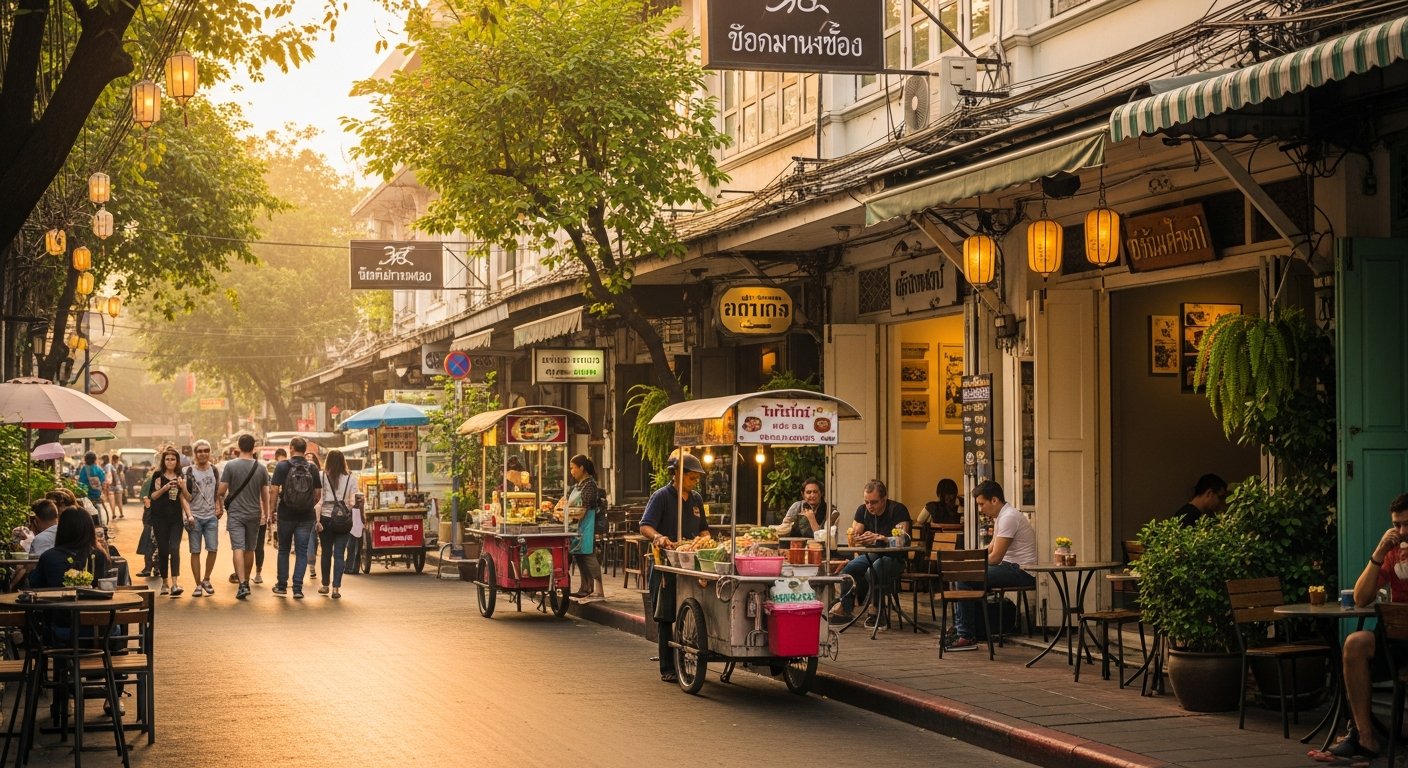
Thonglor (Sukhumvit Soi 55) is Bangkok’s most dynamic neighborhood — a concentration of Japanese restaurants, rooftop bars, coworking spaces, boutique gyms, and the kind of restaurants that require reservations. It’s where Bangkok’s young professionals live and play, and there’s an energy here that other neighborhoods can’t replicate.
The rent is higher. A decent one-bedroom starts at ฿20,000 and a nice one pushes ฿35,000–45,000. But you’ll spend less on transport because everything is within walking or motorcycle-taxi distance. The Japanese food alone justifies the premium if you care about that sort of thing.
Ekkamai: Thonglor’s Quieter Neighbor
One BTS stop from Thonglor, Ekkamai offers most of the same access at 60–70% of the price. The soi has its own cafes, restaurants, and a growing coworking scene. It’s residential enough to feel like an actual neighborhood rather than an entertainment district.
The Eastern Bus Terminal is here, which is useful if you’re planning weekend trips to Pattaya, Koh Samet, or the eastern coast. Gateway Ekkamai mall sits right at the BTS station with a cinema, supermarket, and surprisingly good Japanese food court.
On Nut: The Budget Play That Actually Works
On Nut is where the math gets interesting. Rents drop 40–50% compared to Thonglor, but you’re only three BTS stops away. The neighborhood has Tesco Lotus (now Lotus’s), Big C, and enough street food vendors to eat differently every night for a month. The condos are newer than what you’d find at the same price in central Sukhumvit, and many come with pools, gyms, and co-working lobbies.
The honest downside: On Nut is less walkable than Ari or Thonglor. The streets are wider, the distances longer, and the sidewalk quality drops. You’ll use motorcycle taxis more. But at ฿10,000/month for a furnished studio with a pool, the value is hard to argue with.
Condos vs. Serviced Apartments: Which One?
Condos (rented from individual owners via Hipflat, DDProperty, Facebook groups, or agents) give you more space, lower prices, and a local feel. Most come fully furnished with kitchen, washer, wifi, and building amenities like a pool and gym. Monthly contracts are common — you’ll typically pay first month + one month deposit. Negotiate. Always negotiate.
Serviced apartments (Oakwood, Somerset, or smaller local brands) cost 30–50% more but include cleaning, fresh towels, a front desk, and zero hassle. If you’re here for exactly one month and don’t want to deal with setting up utilities, buying kitchen supplies, or communicating with a Thai landlord via Line, serviced apartments earn their premium.
The middle ground: Airbnb. The Bangkok Airbnb market is competitive, which means prices are reasonable for monthly stays (฿15,000–30,000 for a decent one-bedroom in Sukhumvit). The advantage is reviews from other long-stayers, clear expectations, and a cancellation policy. The disadvantage is you’re technically operating in a legal gray area — Thailand has restrictions on short-term rentals, though enforcement for individual units is effectively nonexistent.
My recommendation: For your first month, use Airbnb or a serviced apartment. You can see the neighborhood, test the commute, and learn the building before committing to a longer condo lease if you decide to stay.
Visa Options: How to Stay Legally
Thailand gives most passport holders 30 or 60 days visa-free (depending on nationality). If you want to stay longer, you have real options now. The days of doing visa runs to the Cambodian border every month are mostly over.
Tourist Visa (TR): 60 days, extendable by 30 days at immigration for ฿1,900. Applied for at a Thai embassy before arrival. Simple and sufficient for a single month-long stay.
Destination Thailand Visa (DTV): The game-changer introduced in 2024. A 180-day multiple-entry visa for remote workers, freelancers, and digital nomads. Costs ฿10,000 (~$280). You can work remotely on this visa — Thailand officially acknowledges that people do this. The application requires proof of remote employment or freelance work. This is the visa most digital nomads should be looking at.
Thailand Elite Visa: The premium option. 5-year membership starting at ฿600,000 (~$17,000). Includes unlimited entries, fast-track immigration, airport transfers, and a concierge. Sounds expensive, but amortized over 5 years it’s ฿10,000/month — not unreasonable if you’re committed to Thailand as a base. The 20-year option exists at ฿1,000,000+.
Education Visa (ED): Enroll in a Thai language school, Muay Thai program, or cooking school. 90-day to 1-year visa depending on the program. Costs vary — Thai language schools run ฿20,000–40,000 for a year of lessons plus the visa paperwork. The classes are usually 2–4 hours per week and genuinely useful if you want to learn the language. Some schools are essentially visa factories with minimal actual teaching. Research before committing.
Important: Do not work for Thai clients or Thai companies on any tourist-type visa. Remote work for foreign employers exists in a gray area that the DTV now addresses. Teaching English requires a work permit. The distinction matters.
The Coworking Situation
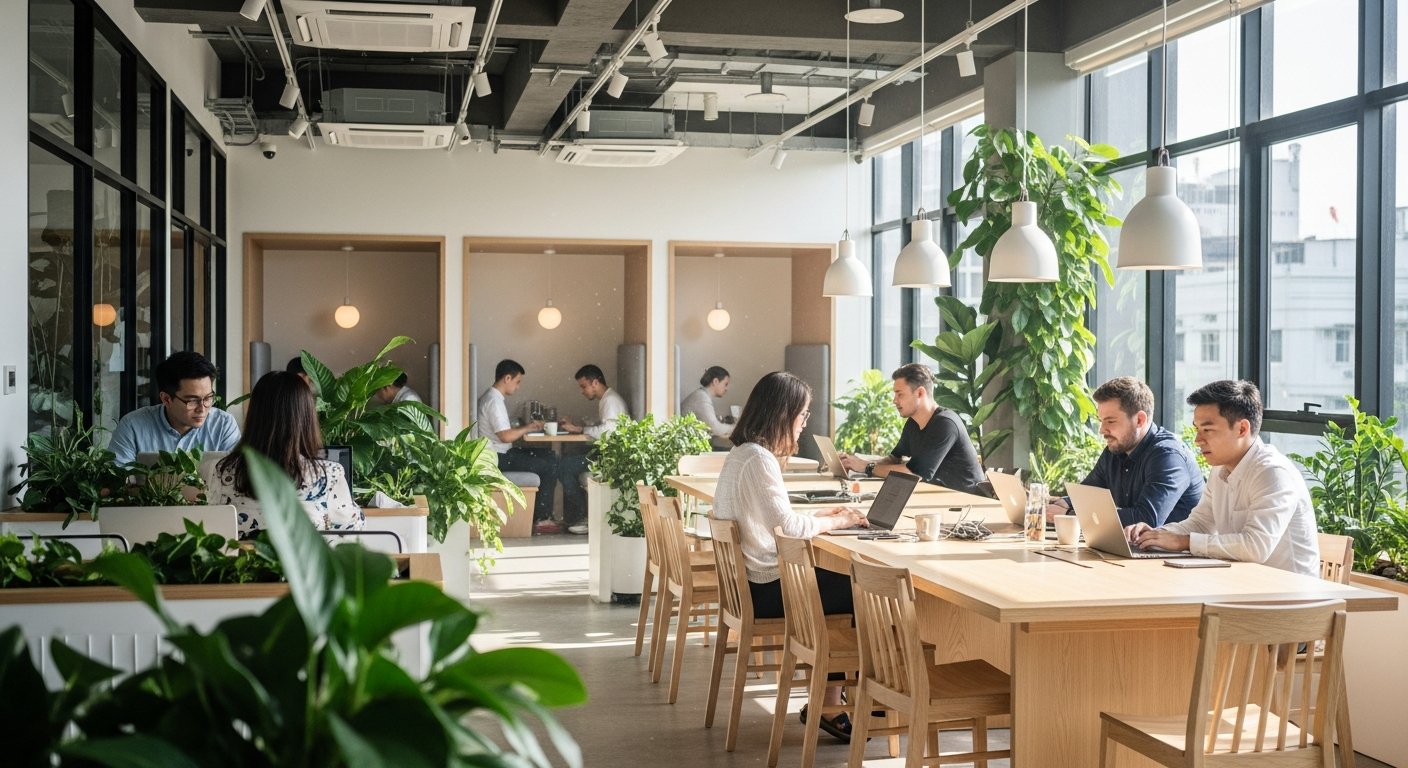
Bangkok’s coworking scene matured significantly around 2023–2025. You’re not limited to coffee shops anymore — though Bangkok coffee shops are excellent places to work if you pick the right ones.
Top coworking options:
The Hive (Thonglor, Sathorn, Prakanong) — The most established chain. Day passes from ฿350, monthly hot desks from ฿4,500. Good community, reliable wifi (100+ Mbps), meeting rooms bookable by the hour. The Thonglor branch has the best crowd — a mix of Thai startups and foreign remote workers.
True Digital Park (Punnawithi) — A massive complex two BTS stops past On Nut. Monthly from ฿3,000. Less centrally located but the facilities are excellent and the community events are well-organized.
Glowfish (Sathorn, Sukhumvit) — Corporate-leaning but friendly to freelancers. Monthly from ฿5,000. The Sathorn branch has particularly good views.
JustCo (multiple locations) — International chain with consistent quality. Monthly from ฿5,500.
The free option: Many Bangkok condos now include co-working lobbies with decent wifi. Combine that with the cafe rotation method — two hours at a different cafe each day, buying one drink per session — and you can work comfortably for ฿0–100/day.
For getting around between your condo, coworking space, and everywhere else, our Bangkok transportation guide covers every option and cost.
What a Typical Day Looks Like
Nobody asks this question, but everybody wonders about it. Here’s a realistic Tuesday for a mid-range digital nomad in Thonglor:
7:00 AM — Wake up. The condo gym is empty before 8. Thirty minutes on the treadmill with the pool visible through the glass wall. This costs ฿0 because the gym is included in the rent.
8:00 AM — Breakfast from a street vendor on Soi 55. Joke (rice porridge) or khai jiao (Thai omelet on rice). ฿40–60.
8:30 AM — Walk or motorcycle taxi to coworking space or cafe. ฿10–25.
9:00 AM–12:30 PM — Work. Bangkok wifi is genuinely excellent — most coworking spaces hit 100+ Mbps, and even cafes reliably deliver 30–50 Mbps.
12:30 PM — Lunch. A local Thai restaurant or food court. Pad kra pao, green curry, or whatever the daily special is. ฿60–120.
1:30 PM–5:30 PM — More work. The afternoon heat peak (1–3 PM) is why Bangkok’s indoor culture exists. Nobody judges you for spending four hours in an air-conditioned cafe.
6:00 PM — Gym, pool, or a ฿300 Thai massage. This is the golden hour where Bangkok’s quality of life becomes undeniable.
7:30 PM — Dinner. Explore a different neighborhood or find a spot on Sukhumvit’s local food scene. ฿100–300 depending on ambition.
9:00 PM — Evening options: rooftop drinks, night market, movie (฿200 for VIP recliner seats), or just a walk along the Sukhumvit strip.
The routine works because Bangkok’s cost structure means you never have to choose between productivity and quality of life. The massage after work isn’t a luxury — at ฿300/hour, it’s cheaper than a single cocktail at a New York bar.
The Honest Pros and Cons
Pros:
The cost of living is real. A comfortable lifestyle here costs less than a modest lifestyle in most Western cities. You’re not roughing it — you’re living better for less.
The food is world-class, varied, and available 20 hours a day. Street food at midnight isn’t a novelty, it’s a Tuesday.
Infrastructure works. BTS runs on time. Grab arrives in 3 minutes. Amazon delivers in a day. You have high-speed internet, modern hospitals, and every international chain you could want.
The weather never gets cold. If you hate winter, Bangkok permanently solves that problem. November through February is genuinely beautiful — low humidity, clear skies, 28-30 degrees.
Cons:
The heat. March through May is brutal — 37-40 degrees with high humidity. Your entire outdoor schedule shifts. You learn to plan around air conditioning.
Air quality. December through February brings burning season smoke from the north. Bangkok’s AQI spikes above 150 regularly during this period. If you have respiratory issues, time your stay carefully.
Bureaucracy. Anything involving Thai government offices — immigration extensions, driver’s licenses, bank accounts — requires patience, paperwork, and usually multiple visits.
Loneliness is real if you don’t build routines. Bangkok’s transient expat population means friendships have a shelf life. People leave. Coworking communities and regular spots help.
Language barrier. You can live in Bangkok without speaking Thai. You cannot deeply enjoy Bangkok without speaking Thai. Even 50 basic phrases change the entire experience.
Frequently Asked Questions
Can I really work remotely from Bangkok legally?
Yes, with the right visa. The Destination Thailand Visa (DTV) explicitly covers remote workers employed by foreign companies. Before the DTV, working remotely on a tourist visa was technically illegal but universally practiced. The DTV eliminated that gray area for ฿10,000. If you’re freelancing for international clients or employed by a foreign company, the DTV is the straightforward answer.
Is Bangkok safe for solo long-stayers?
Bangkok is one of the safest major cities in Southeast Asia for foreigners. Violent crime against tourists is extremely rare. Scams exist — gem shops, tuk-tuk tours, rigged taxi meters — but they target short-term tourists, not residents. Standard urban awareness applies: don’t flash valuables, don’t get involved in anything illegal, and you’ll be fine. Most long-stayers report feeling safer in Bangkok than in their home cities.
What about health insurance and hospitals?
Thai hospitals are excellent — Bumrungrad, Samitivej, and Bangkok Hospital are internationally accredited and frequently cheaper than Western hospitals even without insurance. A GP visit costs ฿500–1,500. Most digital nomads use international health insurance (SafetyWing at $45/month is the popular budget option, or Cigna Global for comprehensive coverage). Don’t skip this. A hospital stay without insurance, even in Thailand, can hit ฿100,000+.
When is the best month to start a long stay?
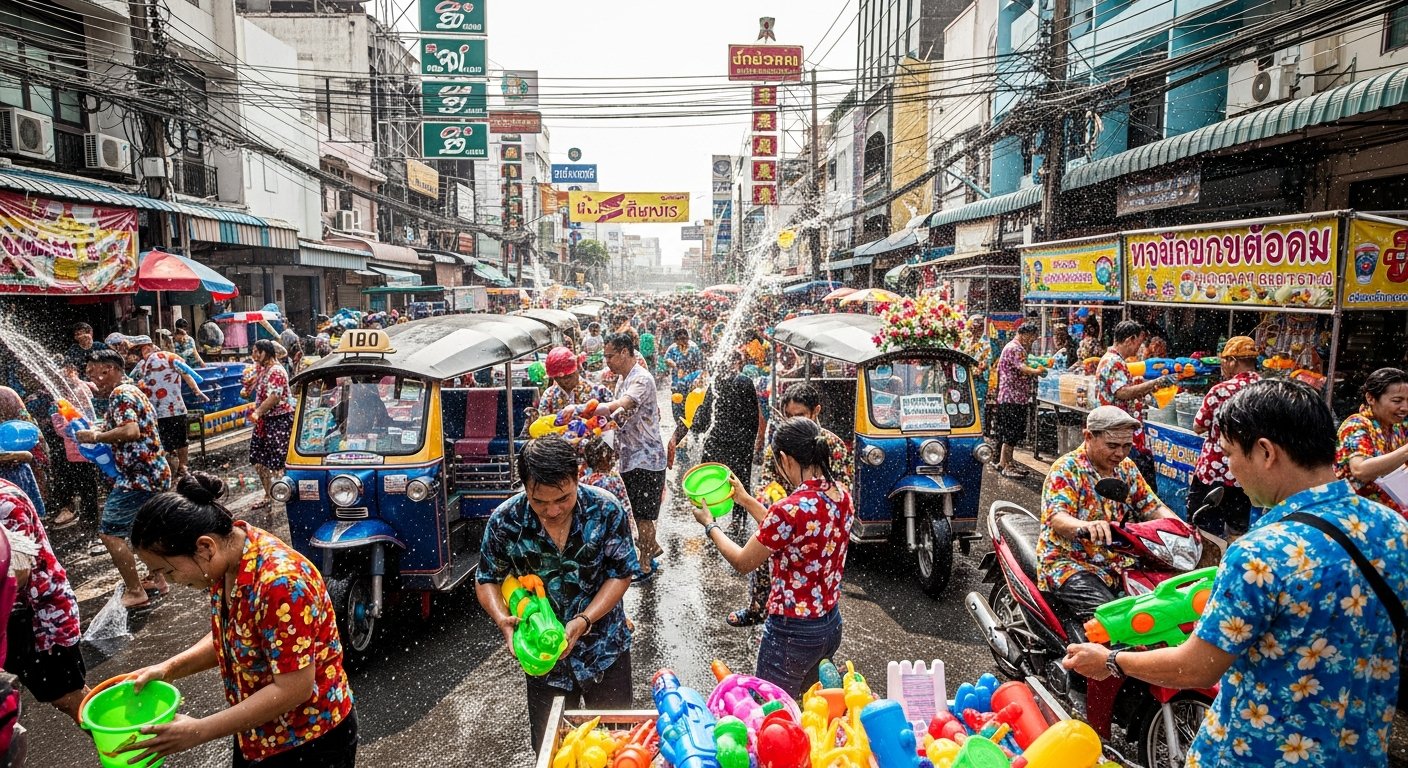
November. The rainy season ends, the cool season begins, the humidity drops, and Bangkok becomes genuinely pleasant to walk around in. The November-February window is peak quality of life. Avoid April if heat bothers you — it’s the hottest month, and Songkran (water festival) shuts down normal city operations for a week.
How do I find an apartment for just one month?
Start with Airbnb for furnished monthly stays with clear terms. Facebook groups (Bangkok Expats, Bangkok Digital Nomads) have daily listings. Hipflat.co.th and DDProperty.com list condos — message agents directly and specify you want a monthly contract. Walk-in inquiries at condo buildings also work surprisingly well. Expect to pay first month + one month security deposit. Many landlords are flexible on start dates and contract lengths if you pay on time.
The Bottom Line
Living in Bangkok for a month costs less than you think, works better than you expect, and creates a specific problem: you’ll start comparing every other city to it. The combination of low costs, excellent food, reliable infrastructure, and genuine warmth — both climate and cultural — is difficult to replicate anywhere else in the world.
The one-month experiment almost always ends one of two ways: you leave knowing this isn’t for you, or you start looking at six-month leases. Very few people leave feeling neutral about Bangkok. The city demands a verdict.
Start with a month. See what happens.